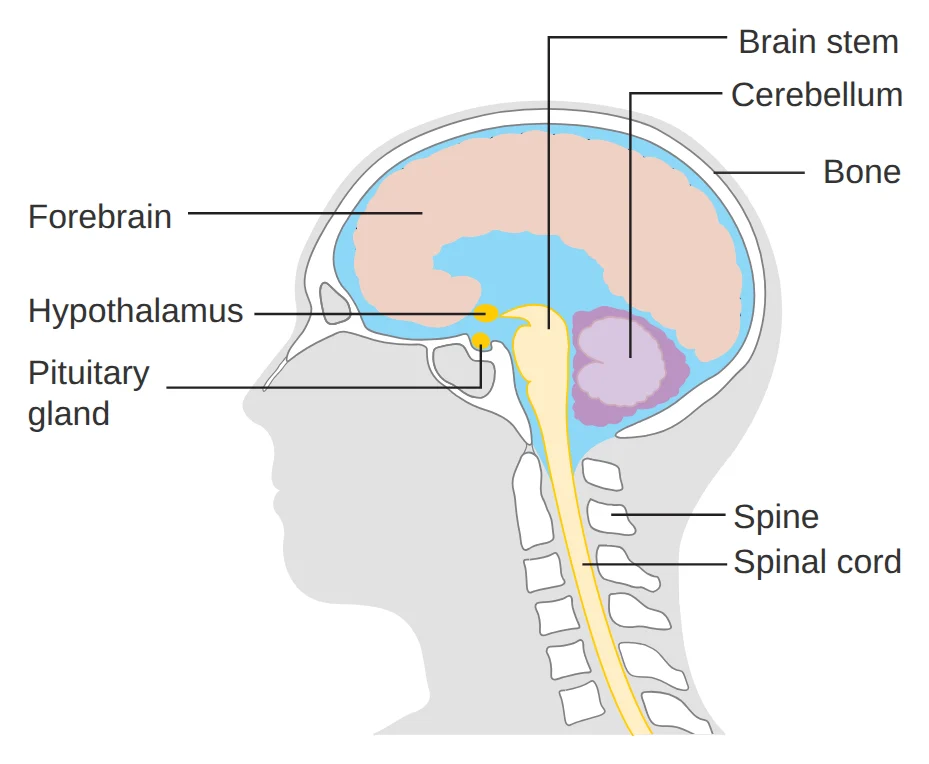
The symptoms of a brain tumour depend on where it is and how big it is: seizures, weakness or numbness, problems with speech, vision or hearing, loss of balance, changes in personality or behaviour, unusual sleepiness, frequent nausea and vomiting, and headaches that are worse in the morning or ease after vomiting [1]. Most headaches have nothing to do with a tumour, and a headache on its own is very rarely a sign of one [2]. But a new or changed headache with these symptoms, or a first seizure in adulthood, should be checked promptly [2, 3].
Key points
- The symptoms of a brain tumour depend on where it is in the brain; each part of the brain does a different job [1].
- A first seizure in adulthood should always be investigated [2].
- In a large study, of every 1,000 people who saw their family doctor only because of headache, fewer than one had a brain tumour [2].
- Tumour headaches mostly resemble ordinary headaches; what is worrying is a change in the headache pattern, nausea or vomiting with it, and other signs of a brain problem [3].
- The main test to find a tumour is an MRI scan of the brain with contrast [1, 6].
Symptoms of a brain tumour
When a tumour grows or presses on the tissue around it, it disrupts the work of that part of the brain [1]. That is why symptoms differ from person to person and depend on the tumour's location, its size and what that part of the brain controls [1]. Tumours that reach the brain from elsewhere in the body (brain metastases) are more common than tumours that start in the brain, and cause the same symptoms [1].
| Symptom | Explanation | What to do |
|---|---|---|
| Seizure | Especially a first seizure in adulthood; one of the strongest signs [1, 2] | First seizure: go to an emergency department the same day |
| New weakness or numbness in an arm, leg or one side of the body | If it gets gradually worse over days or weeks, it needs prompt assessment [1, 6] | Sudden: emergency straight away (it may be a stroke) |
| Trouble speaking or understanding others | A symptom [1] | Sudden: emergency straight away; gradual: see a doctor soon |
| Problems with vision or hearing | A symptom [1] | See a doctor soon |
| Loss of balance and difficulty walking | A symptom [1]; common in children [7] | See a doctor soon |
| Changes in personality, mood, behaviour or concentration, forgetfulness or confusion | A symptom [1, 2] | If people around you notice a new change, see a doctor |
| Morning headache, or a headache that eases after vomiting | A symptom [1]; headache alone is a weak sign [2] | If it is new or getting worse, see a doctor |
| Frequent nausea and vomiting, loss of appetite | A symptom [1] | If no other cause is found, see a doctor |
| Unusual sleepiness or reduced activity | A symptom [1] | Severe or worsening sleepiness: emergency |
This table does not replace an examination by a doctor; these symptoms can also have other causes [1].
When is a headache worrying?
Headache is very common, and only a small minority of people have an underlying cause such as a tumour [2, 4]. Tumour headaches also mostly resemble ordinary tension-type headaches; the "classic" early-morning tumour headache is less common than people think [3]. These features make a more serious cause more likely and are worth having checked [3, 4]:
- a new headache, especially if it started after age 65, or a headache whose pattern has changed
- a headache that gets worse day by day or week by week
- headache with nausea or vomiting
- headache made worse by coughing, sneezing, exercise or bending over, or that changes with body position (lying down or standing up)
- headache with weakness, numbness, changes in speech or vision, confusion or a seizure
- a new headache in someone with a history of cancer, who is pregnant or has a weakened immune system
A sudden, very severe headache, or a headache with fever, is an emergency and must be checked straight away [4].
When should I call my doctor?
Go to an emergency department or call your local emergency number straight away if [2, 4]:
- you have a seizure for the first time
- you suddenly develop weakness or numbness on one side of the body, a drooping face, slurred or lost speech, or severe loss of vision (these can also be signs of a stroke)
- you have a sudden, very severe headache, or a headache with fever, confusion or severe sleepiness
Book a doctor's appointment within the next few days if [3, 6]:
- weakness, numbness, or problems with speech, vision or balance are slowly getting worse over days or weeks
- you have a new or changed headache that keeps getting worse or comes with vomiting
- you or the people around you notice a new change in behaviour, memory or personality
In children, show a doctor promptly a persistent headache, repeated vomiting, a new problem with walking or coordination, a new squint, or a growing head size in young children [6, 7].
The path to diagnosis
- 1
Neurological examination
With a few questions and simple tests, the doctor checks alertness, coordination, walking, muscle strength, the senses and reflexes; a visual field test may also be done [1].
- 2
- 3
Biopsy
The type of tumour is found by examining tissue removed during surgery or with a needle; genetic tests on the tumour also help choose treatment [1].
- 4
If a tumour is found
Not all brain tumours are cancer; some are benign, but because they press on the brain they also cause symptoms and need treatment [1]. Read more: Brain tumours and the difference between benign and malignant tumours
Who is at higher risk?
The cause of most adult brain tumours is unknown, and few risk factors are known [1]. The only environmental factor that has been firmly established is ionising radiation, for example previous radiotherapy to the head [8]. A few rare inherited conditions also raise the risk, such as neurofibromatosis types 1 and 2, von Hippel-Lindau disease, tuberous sclerosis and Li-Fraumeni syndrome [1]. A severely weakened immune system (such as AIDS or an organ transplant) raises the risk of lymphoma of the brain [1].
If you have another cancer, especially lung cancer, tell your doctor promptly about any new brain symptoms; up to half of tumours that spread to the brain come from lung cancer [1].
Frequently asked questions
Could my daily headaches be a brain tumour?
Very probably not. In a large study, of every 1,000 people who saw their family doctor with headache, fewer than one had a brain tumour [2]. A headache that has been the same for years and comes with no other symptoms usually has a harmless cause. But if the headache is new, its pattern has changed, or it comes with vomiting or other symptoms, tell your doctor [3, 4].
What does a brain tumour headache feel like?
In a study of 111 patients, nearly half had headaches, and these mostly resembled an ordinary tension-type headache, usually across the front of the head and worse on the side of the tumour [3]. In about 1 in 3 it got worse on bending over, and about 4 in 10 had nausea or vomiting [3]. The "classic" early-morning headache was uncommon [3].
I have headaches. Do I need an MRI?
Do mobile phones cause brain tumours?
Current evidence says no. A large review commissioned by the World Health Organization, which pooled 63 papers, concluded with moderate certainty that mobile phone use probably does not increase the risk of glioma, meningioma or other brain tumours in adults or children, even in people who had used phones for many years or a great deal [9].
What are the symptoms of a brain tumour in children?
In a review of more than 4,000 children, the most common symptoms were headache, nausea and vomiting, problems with walking and coordination, and swelling of the optic nerve head (which a doctor sees when examining the eye) [7]. In children under 4, a growing head, vomiting, irritability and lethargy were more common [7]. More than half of the children had no signs of raised pressure inside the head, so several symptoms together matter [7].
Is a brain tumour always cancer?
Are brain tumours hereditary?
Mostly not. The cause of most adult brain tumours is unknown, and only a few rare inherited conditions raise the risk [1]. Read more: is cancer hereditary?
Referral and imaging criteria (for physicians)
For physicians
NICE NG12 (updated 15 April 2026). Adults with progressive, sub-acute loss of central neurological function: consider an urgent direct access MRI scan of the brain (or CT if MRI is contraindicated) within 2 weeks (recommendation 1.9.1). Children and young people (up to age 24) with newly abnormal cerebellar or other central neurological function: consider a very urgent referral (within 48 hours) (1.9.2) [6].
Positive predictive values in primary care. In a GPRD case-control study (3,505 patients with primary brain tumours and 17,173 controls; background risk 0.013%): new-onset seizure 1.2% (95% CI 1.0 to 1.4), weakness (as a symptom) 3.0% (1.7 to 4.9), confusion 0.20% (0.16 to 0.24), headache 0.09% (0.08 to 0.10), memory loss 0.036%, visual disorder 0.035% and motor loss on examination 0.026%. The highest risk with headache or new-onset seizure was at age 60 to 69 (0.13% and 2.3%). The authors concluded that isolated headache at first presentation does not warrant investigation, but new-onset seizures should be investigated [2].
Risk stratification for imaging from primary care. Red flags: risk of tumour above 1%; orange flags: 0.1 to 1%; yellow flags: below 0.1% but above the background population rate of 0.01%. Normal imaging does not remove the need for follow-up and appropriate headache management, and important secondary causes of headache with normal imaging should not be overlooked [5].
Headache features. In 111 patients with primary (34%) or metastatic (66%) brain tumours, headache was present in 48%: tension-type-like in 77% and migraine-like in 9%; worse with bending over in 32% and with nausea or vomiting in 40%; the "classic" early-morning headache was uncommon, and headache was the worst symptom in only 45%. Nausea, vomiting, an abnormal neurological examination or a significant change in the prior headache pattern suggest a tumour cause [3]. The SNNOOP10 list for secondary headache: systemic symptoms including fever, neoplasm history, neurological deficit (including decreased consciousness), sudden or abrupt onset, onset after age 65, pattern change or recent onset, positional headache, precipitation by sneezing, coughing or exercise, papilloedema, progressive headache and atypical presentations, pregnancy or puerperium, painful eye with autonomic features, post-traumatic onset, immune system pathology such as HIV, and painkiller overuse or a new drug at onset [4].
Children. In a meta-analysis of 74 studies (4,171 children) with intracranial tumours: headache 33%, nausea and vomiting 32%, abnormal gait and coordination 27% and papilloedema 13%; under 4 years: macrocephaly 41%, nausea and vomiting 30%, irritability 24% and lethargy 21%. Symptoms of raised intracranial pressure were absent in more than half [7].
Related cancer types
References
9 referencesShow all referencesClose the reference list
Numbers in the text, such as [1], refer to these sources. Sources with a “Study card” button are summarised in the site’s evidence library.
- 1
- 2
- 3
- 4
- 5
- 6
- 7
- 8Risk factors for childhood and adult primary brain tumors
- 9The effect of exposure to radiofrequency fields on cancer risk in the general and working population: A systematic review of human observational studies - Part I: Most researched outcomes
This page is based on reputable scientific sources and was last updated on 28 October 2026. The content of this website is for educational and informational purposes only and does not replace consultation, diagnosis or treatment by a specialist physician. Consult your treating physician about any treatment decision.
Printed from the website; the full and up-to-date version: https://drdabiri.com/en/questions/symptoms-of-brain-tumor/