The most important symptom of endometrial (womb) cancer is any bleeding or spotting after the menopause; about 9 in every 10 women with this cancer have had it [1]. In women who still have periods, bleeding that is not related to a period or very heavy periods can be a sign; unusual discharge, pelvic pain and pain during sex can also occur [2, 3]. Most bleeding after the menopause has another cause, but a doctor should check it every time; because this symptom appears early, most patients are diagnosed at a stage that can be treated successfully [1, 3].
Key points
- Any bleeding after the menopause, even a small spot or a single episode, should be shown to a doctor [1, 8].
- About 9 in 10 women with endometrial cancer have had bleeding after the menopause; but of every 10 women who have this bleeding, only about one has cancer [1].
- Because this symptom appears early, most patients are diagnosed at stage 1 and treated with surgery [3, 6].
- A Pap smear does not find this cancer, and there is no routine screening test for endometrial cancer; paying attention to symptoms is the main way to find it early [3, 7].
- Obesity, diabetes, taking tamoxifen, oestrogen-only hormone therapy and Lynch syndrome raise the risk [5].
Symptoms of endometrial (womb) cancer
| Symptom | Explanation | What to do |
|---|---|---|
| Bleeding or spotting after the menopause | The most important and most common symptom [1, 3] | See a doctor even if it was light or happened only once |
| Bleeding or discharge not related to periods | For example, bleeding between periods [2] | If it is new or keeps happening, see a doctor |
| Very heavy periods | Can be the first sign [3] | If this is a new change, see a doctor |
| New, unusual vaginal discharge, especially after age 55 | A symptom [2, 8] | If it continues, see a doctor |
| Pelvic pain or pain during sex | A symptom [2] | If it continues, see a doctor |
| Difficult or painful passing of urine | A symptom [2] | If it is not a urine infection and it continues, see a doctor |
This table does not replace an examination by a doctor; most of these symptoms have a cause other than cancer [1].
How endometrial (womb) cancer differs from cervical cancer
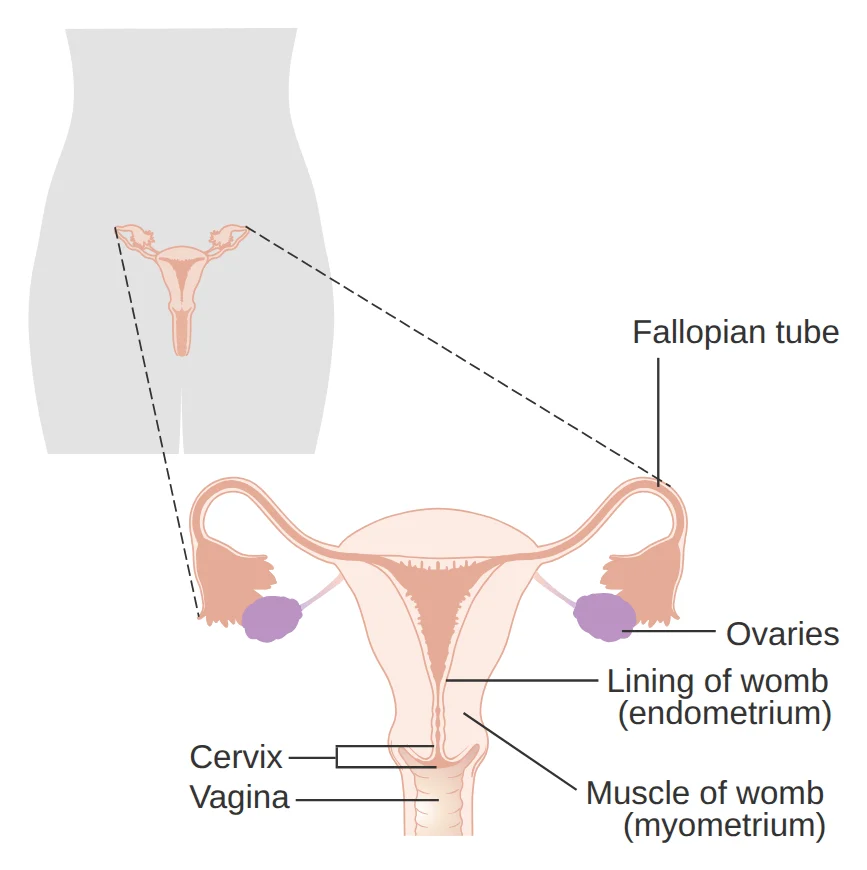
"Womb" or "uterine" cancer usually means endometrial cancer; the other type, a sarcoma that starts in the muscle wall of the womb, is rare [4]. Endometrial cancer and cervical cancer affect the same organ, but they are two separate diseases with different causes, tests and treatment:
- Where: the endometrium is the inner lining of the womb [3]; the cervix is the lower part of the womb that opens into the vagina [10].
- Cause: endometrial cancer is mostly linked to too much oestrogen in the body and to obesity [3, 6]; cervical cancer almost always comes from a long-lasting HPV infection [10].
- Age: the risk of endometrial cancer rises with age and it is mostly seen after the menopause [1, 3]; cervical cancer more often affects younger women too [10].
- Finding it early: cervical cancer has HPV tests and Pap smears [10]; endometrial cancer has no routine screening test, and a Pap smear is not reliable for it [3, 7].
See the symptoms of cervical cancer in symptoms of cervical cancer.
When should I call my doctor?
See a gynaecologist or your family doctor as soon as you can for any of these [1, 8]:
- any bleeding or spotting after the menopause (once you have had no periods for at least a year), even if it was light and happened only once
- bleeding between periods, or periods that have suddenly become much heavier
- new, unusual vaginal discharge, especially after age 55
- any unusual vaginal bleeding if you take tamoxifen or have taken it in the past [3]
If you take menopausal hormone therapy and have bleeding outside its expected pattern, tell your doctor about that too [8].
Heavy vaginal bleeding, or bleeding with dizziness and weakness, needs urgent care at an emergency department.
The path to diagnosis
- 1
Examination and transvaginal ultrasound
The doctor examines the pelvis and uses an ultrasound scan through the vagina to measure the thickness of the lining of the womb [3].
- 2
Endometrial biopsy
A thin, flexible tube passed through the cervix into the womb takes a small piece of the lining; only examining a tissue sample can confirm cancer [3]. The American College of Obstetricians and Gynaecologists now recommends both an ultrasound scan and a biopsy for most women with bleeding after the menopause [9].
- 3
Hysteroscopy or curettage
Sometimes the doctor looks inside the womb with a thin camera (hysteroscopy) or takes more tissue by dilatation and curettage [3].
- 4
If cancer is confirmed
The main treatment for most patients is surgery to remove the womb (hysterectomy), and for many of them this operation cures the disease [6]. Read more: Endometrial (womb) cancer
Who is at higher risk?
The risk of endometrial cancer rises with age [3]. Most other risk factors come down to too much oestrogen in the body without enough of the hormone that balances it (progesterone) [3, 5]:
- obesity and weight gain in adulthood, the main reason this cancer is becoming more common worldwide [5, 6]
- type 2 diabetes and metabolic syndrome (extra fat around the waist, high blood sugar, high blood pressure and high blood fats) [5]
- taking tamoxifen (a breast cancer medicine) for more than 2 years, especially after the menopause [5]
- menopausal hormone therapy with oestrogen only; oestrogen combined with progestogen does not raise this risk [5]
- never having been pregnant, early first periods, late menopause and polycystic ovary syndrome [5]
- Lynch syndrome (an inherited condition) and womb cancer in a mother, sister or daughter [5]
If you take tamoxifen, do not stop it on your own; routine ultrasound scans without symptoms are not needed, but report any unusual bleeding to your doctor promptly [7]. If several relatives have had womb or bowel cancer, read: is cancer hereditary?
Frequently asked questions
I had spotting once after the menopause. Should I be worried?
Does a Pap smear show womb cancer?
My ultrasound was normal. Do I still need a biopsy?
You may. In 2026 the American College of Obstetricians and Gynaecologists recommended both an ultrasound scan and a biopsy for most women with bleeding after the menopause; an ultrasound alone is enough only for a small group who have had a single episode of bleeding, whose womb lining was fully seen and is thin, and who have no important risk factors [9]. If the bleeding continues or comes back, see your doctor again [9].
Can young women get womb cancer?
Can womb cancer be cured?
Can I lower my risk of womb cancer?
To some extent. The combined contraceptive pill, pregnancy and breastfeeding are linked to a lower risk, and physical activity may lower it too [5]. Weight-loss (bariatric) surgery has lowered the risk [5]. In a woman who still has her womb, menopausal oestrogen is usually not prescribed on its own [5].
Referral criteria and assessment (for physicians)
For physicians
NICE NG12 (updated 15 April 2026). Age 55 and over with unexplained post-menopausal bleeding (PMB) that cannot be attributed to HRT: suspected cancer pathway referral (diagnosis or exclusion within 28 days; recommendation 1.5.12). Under 55: consider the same referral (1.5.14). Consider an urgent direct access ultrasound scan (within 2 weeks) at age 55 and over with unexplained vaginal discharge presenting for the first time or with thrombocytosis or haematuria, or with visible haematuria and low haemoglobin, thrombocytosis or high blood glucose (1.5.13). For unscheduled bleeding on HRT, NG12 signposts the British Menopause Society guidance (1.5.15) [8].
Value of PMB. In a meta-analysis of 129 studies (40,790 women), the pooled prevalence of PMB among women with endometrial cancer was 91% (95% CI 87 to 93%), irrespective of stage; the pooled risk of endometrial cancer among women with PMB was 9% (8 to 11%), varying from 7% to 12% by hormone therapy use and from 5% (North America) to 13% (Western Europe) by region [1].
Assessment (ACOG, April 2026). This focused update of Committee Opinion No. 734 (2018) recommends transvaginal ultrasound together with endometrial sampling in the initial evaluation of most patients with PMB. Ultrasound without sampling is acceptable only after a single episode of bleeding, with a fully visualised endometrium 4 mm thick or less, no factors strongly associated with endometrial cancer (such as BMI above 30, diabetes, tamoxifen or hormone use, genetic predisposition), counselling that persistent or recurrent bleeding needs prompt re-evaluation, and no barriers to prompt gynaecological assessment [9].
Other points. A definitive diagnosis requires direct sampling of the endometrium, and cervical cytology is not a reliable screening test for endometrial cancer [3]. Any abnormal bleeding in a woman taking tamoxifen requires examination and endometrial biopsy [3]; transvaginal ultrasound is not useful for screening asymptomatic users [7]. The most common cause of death in patients with endometrial cancer is cardiovascular disease, owing to shared metabolic risk factors [3].
Related cancer types
Related questions
References
10 referencesShow all referencesClose the reference list
Numbers in the text, such as [1], refer to these sources. Sources with a “Study card” button are summarised in the site’s evidence library.
- 1
- 2
- 3
- 4Uterine Cancer
- 5
- 6
- 7
- 8
- 9
- 10
This page is based on reputable scientific sources and was last updated on 28 October 2026. The content of this website is for educational and informational purposes only and does not replace consultation, diagnosis or treatment by a specialist physician. Consult your treating physician about any treatment decision.
Printed from the website; the full and up-to-date version: https://drdabiri.com/en/questions/symptoms-of-endometrial-cancer/