Early cervical cancer usually causes no symptoms at all, which is why regular HPV tests or Pap smears matter [1, 2]. When it does cause symptoms, the most common sign is unusual vaginal bleeding (after sex, between periods, periods that are heavier or longer than usual, or any bleeding after the menopause), together with watery, strong-smelling or bloody discharge and pelvic pain or pain during sex [1]. These symptoms usually have other causes, but the only way to know is to see a doctor, and ignoring them can delay treatment and make it less effective [1].
Key points
- Early cervical cancer is usually silent; symptoms mostly appear once the disease has progressed [1].
- The most common symptom is unusual vaginal bleeding: after sex, between periods, periods heavier or longer than usual, or any bleeding after the menopause [1, 2].
- These symptoms usually have another cause; but the only way to know is an examination by a doctor [1].
- Almost all cases come from a long-lasting HPV infection; the HPV vaccine and regular cervical screening prevent most of these cancers [2, 3].
Symptoms of cervical cancer
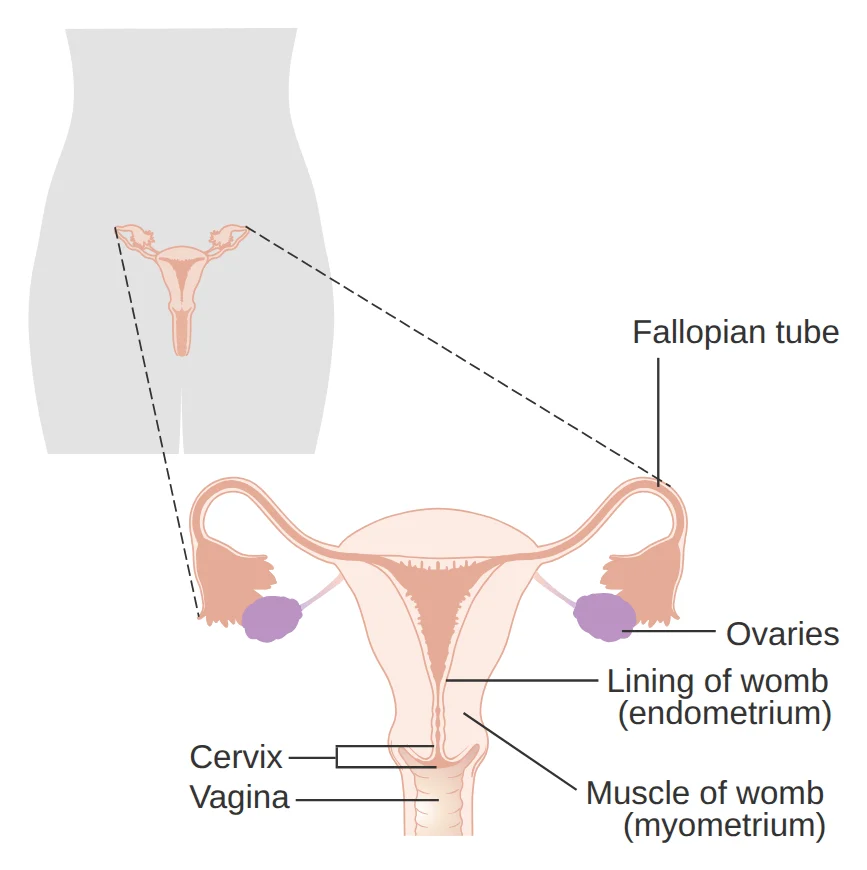
The cervix is the lower, narrow part of the womb (uterus) that opens into the vagina [9]. The symptoms of cervical cancer fall into two groups: those that may appear in the early stages, and those that appear once the disease has spread beyond the cervix [1]. Having one of these symptoms does not mean you have cancer, but it is a good reason to be examined.
| Symptom | Explanation | What to do |
|---|---|---|
| Bleeding after sex | An early-stage symptom [1]; in most women it has another cause [6] | See a doctor to have your cervix examined |
| Bleeding between periods | An early-stage symptom [1] | If it is new or keeps happening, see a doctor |
| Periods heavier or longer than usual | An early-stage symptom [1] | If this is a new change, see a doctor |
| Any bleeding after the menopause | An important symptom [1, 2]; it can also be a sign of womb (endometrial) cancer [5] | See a doctor even if it was light and happened only once |
| Watery, strong-smelling or bloody vaginal discharge | An early-stage symptom [1, 2] | If it continues, see a doctor |
| Pelvic pain or pain during sex | A symptom [1] | If it continues, see a doctor |
| Dull backache, tummy (abdominal) pain or swollen legs | In more advanced disease [1, 2] | See a doctor soon |
| Difficult or painful passing of urine or stools, or blood in the urine or stools | In more advanced disease [1] | See a doctor soon |
| Tiredness, weight loss and loss of appetite | In more advanced disease [1, 2] | See a doctor to find the cause |
This table does not replace an examination by a doctor; these symptoms usually have a cause other than cancer [1].
When should I call my doctor?
If you have any of the following, see a gynaecologist or your family doctor for a cervical examination, and do not wait for it to go away on its own [1]:
- bleeding after sex
- bleeding between periods, or periods that have become heavier or longer than usual
- any bleeding after the menopause, even a spot
- watery, strong-smelling or bloody discharge that continues
- pelvic pain or pain during sex that continues
Go even if your last test was normal. Screening tests are meant for people without symptoms [4]; when you have symptoms, a doctor needs to look at the cervix itself [5].
Heavy vaginal bleeding, or bleeding with dizziness and weakness, needs urgent care at an emergency department.
The path to diagnosis
- 1
- 2
Colposcopy
A close look at the cervix with a lighted magnifying instrument, after a vinegar solution has been applied to show up abnormal areas. A small tissue sample is usually taken at the same visit [7].
- 3
Biopsy
Only a tissue sample examined under a microscope can confirm cancer. The sample is taken with a small instrument in the clinic, or by removing a cone-shaped piece of the cervix [7].
- 4
Staging
If cancer is confirmed, MRI, PET-CT and blood tests show how far it has spread [7]. Read more: Cervical cancer
Who is at higher risk, and which test do I need?
Almost all cervical cancers are caused by a long-lasting infection with high-risk types of HPV. HPV is a very common virus passed on through sexual contact, and most of the time the body clears it on its own [2]. These factors make it more likely that the infection persists and turns into cancer [2]:
- a weakened immune system, for example HIV infection
- smoking
- many births, a first pregnancy at a young age and use of the contraceptive pill
- other sexually transmitted infections
And most important of all: not having regular screening. Most cases of this cancer occur in countries without organised screening programmes; where these programmes have been introduced, cases and deaths have more than halved [3].
Regular screening: the most important step
It usually takes 15 to 20 years for abnormal cervical cells to become cancer [2], which gives regular screening a long window to find and treat precancer. The American Cancer Society recommends an HPV test every 5 years from age 25 to 65; an HPV test plus a Pap smear every 5 years, or a Pap smear alone every 3 years, is also acceptable [4]. The World Health Organization recommends screening every 5 to 10 years from age 30, and every 3 to 5 years from age 25 for women living with HIV [2]. See the plan for your age on the screening page.
Frequently asked questions
Does bleeding after sex mean I have cervical cancer?
Does early cervical cancer cause symptoms?
Which is better, a Pap smear or an HPV test?
An HPV test looks for the virus that causes this cancer, while a Pap smear looks for abnormal cells. The American Cancer Society considers an HPV test every 5 years the preferred method and a Pap smear every 3 years acceptable [4]. What matters most is having one of them regularly.
I have had the HPV vaccine. Do I still need screening?
Can I take the sample for an HPV test myself?
Can cervical cancer be cured?
Yes; it can be cured if it is found early and treated promptly [2]. For early, low-risk cancers there are also operations that keep the ability to have children [3]. Read about treatment at each stage on the cervical cancer page.
What is the difference between cervical cancer and womb cancer?
The cervix is the lower, narrow part of the womb that leads to the vagina; womb (endometrial) cancer starts in the inner lining of the womb itself [9]. They are separate diseases, with different symptoms, causes and tests. See the symptoms of womb cancer in symptoms of womb (endometrial) cancer.
Referral criteria and diagnostic points (for physicians)
For physicians
NICE NG12 (updated 15 April 2026). Consider a suspected cancer pathway referral (diagnosis or exclusion of cancer within 28 days) if, on examination, the appearance of the cervix is consistent with cervical cancer (recommendation 1.5.16). Unexplained post-menopausal bleeding at age 55 and over that cannot be attributed to HRT warrants a suspected cancer pathway referral for endometrial cancer (1.5.12) [5].
Postcoital bleeding. In a systematic review, its point prevalence in the community was 0.7 to 9% and in women with cervical cancer 0.7 to 39%. The estimated risk that a woman in the community who develops postcoital bleeding has cervical cancer ranged from 1 in 44,000 at age 20 to 24 to 1 in 2,400 at age 45 to 54; no data allowed direct calculation of the risk in women presenting to primary care [6].
Diagnosis and staging. Diagnosis is histological: colposcopy with punch biopsy, endocervical curettage, LEEP or cone biopsy; staging with PET-CT, MRI, ultrasound, chest X-ray, full blood count and blood chemistry [7]. In the 2018 FIGO staging, imaging and pathology may be used at any stage: pelvic nodal involvement is IIIC1 and para-aortic involvement IIIC2, with the method recorded as "r" (imaging) or "p" (pathology) [10].
Screening. American Cancer Society (2020): primary HPV testing every 5 years from 25 to 65 (preferred); co-testing every 5 years or cytology every 3 years acceptable; stop after 65 with adequate negative screening in the previous 10 years and no CIN2 or worse in the past 25 years [4]. World Health Organization: a high-performance test every 5 to 10 years from age 30; every 3 to 5 years from age 25 in women living with HIV; self-collected samples are reliable for HPV testing [2].
Related cancer types
References
10 referencesShow all references, 4 with a study cardClose the reference list
Numbers in the text, such as [1], refer to these sources. Sources with a “Study card” button are summarised in the site’s evidence library.
- 1
- 2
- 3
- 4
- 5
- 6
- 7
- 8HPV Vaccination and the Risk of Invasive Cervical Cancer
- 9
- 10Revised FIGO staging for carcinoma of the cervix uteri
This page is based on reputable scientific sources and was last updated on 28 October 2026. The content of this website is for educational and informational purposes only and does not replace consultation, diagnosis or treatment by a specialist physician. Consult your treating physician about any treatment decision.
Printed from the website; the full and up-to-date version: https://drdabiri.com/en/questions/symptoms-of-cervical-cancer/