In non-pregnant adults, a white blood cell count above 11,000 per microlitre is called "high", or leucocytosis [1]. The most common causes are simple: infection, physical or emotional stress, hard exercise, surgery, smoking, obesity, pregnancy or medicines such as steroids [1]. But a very high count, immature cells (blasts) on the blood film, or a high count together with anaemia, an abnormal platelet count, an enlarged spleen or lymph nodes, fever, night sweats and weight loss needs assessment by a haematologist [1].
Key points
- The normal white cell count in adults is 4,500 to 11,000 per microlitre, and above 11,000 is considered high; normal values are different in pregnancy and in children [1].
- The most common causes are simple: infection (especially bacterial infection), stress, hard exercise, surgery, smoking, obesity, pregnancy and medicines such as steroids [1].
- It matters which type of white cell has gone up: neutrophils, lymphocytes, monocytes, eosinophils or basophils; each has its own causes [1].
- The first step is usually to repeat the test with a count of each type of white cell and to look at the blood under a microscope (blood film) [1].
- A white cell count above 100,000 is almost always due to leukaemia or a similar bone marrow disease and must be checked urgently [1, 2].
What are white blood cells and why do they go up?
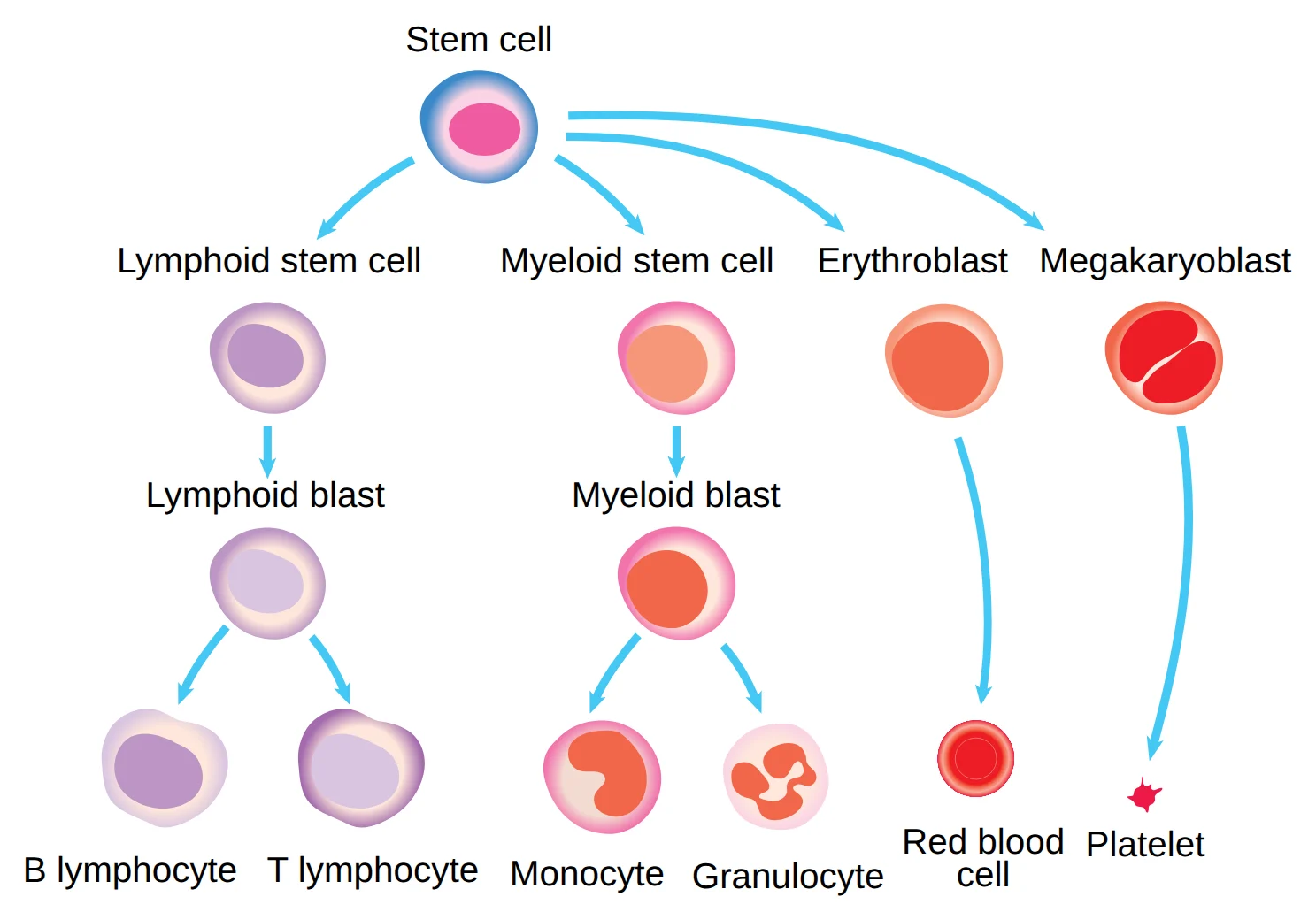
White blood cells are cells of the immune system that fight infection and disease, and they are made in the bone marrow [7]. A CBC report gives the total white cell count (WBC) and the share of each of the five main types: neutrophils, lymphocytes, monocytes, eosinophils and basophils [1]. The absolute count of each type is the total count multiplied by the percentage of that type [1].
The body keeps a large reserve of neutrophils in the bone marrow and stuck to the walls of the blood vessels. This is why the white cell count can double within hours after some triggers, such as stress or infection [1]. A high white cell count has many causes, from harmless ones to blood diseases, and the doctor's job is to tell these two groups apart [1]. The most common type is a rise in neutrophils, which comes from infection, stress, long-term inflammation, medicines and other causes [1].
 (full-size image, opens in a new tab)
Common causes of a high white cell count
| Cause | Explanation | What should I do? |
|---|---|---|
| Infection | One of the most common causes, especially bacterial infections [1] | The doctor looks for other signs of infection and treats it [1] |
| Physical or emotional stress, surgery, injury, burns and hard exercise | Stress hormones release the stored white cells into the blood; after joint replacement surgery, the white cell count rose by about 2,770 on average and peaked on day 2 [1] | Usually temporary; the doctor repeats the test if needed [1] |
| Smoking and obesity | Both are known causes of a high white cell count [1] | Tell your doctor if you smoke |
| Pregnancy | The white cell count rises gradually in pregnancy, and its normal range differs from that of other adults [1] | The doctor compares the count with the normal range for pregnancy [1] |
| Medicines | Steroids (such as prednisolone and dexamethasone), lithium (a medicine for bipolar disorder), airway-opening medicines of the beta-agonist group (such as salbutamol), adrenaline (epinephrine) and injections that boost white cell production [1] | Do not stop any medicine on your own; give your doctor a list of your medicines |
| Long-term inflammatory diseases | Such as rheumatoid arthritis, inflammatory bowel disease or granulomatous diseases [1] | Treatment of the underlying disease under a doctor's care |
| Removal or loss of function of the spleen | The white cell count, especially the lymphocyte count, stays high [1] | Tell your doctor that your spleen has been removed |
| Leukaemia and other bone marrow diseases | An important cause that must be told apart from the harmless ones; symptoms such as fever, weight loss, bruising or tiredness make it more likely [1] | See the section "When is a high white cell count serious?" |
This table does not replace an examination by a doctor. The doctor always interprets the white cell count together with the rest of the CBC, the symptoms and the examination [1].
Which type of white cell is high?
A rise in each type of white cell has its own meaning. The numbers are per microlitre and for adults [1]:
High neutrophils (above 7,000)
The most common type of high white cell count. Usual causes: bacterial infections, stress, hard exercise, surgery, smoking, obesity, pregnancy, steroids and inflammatory diseases [1]. Sometimes it comes from a bone marrow disease; an enlarged spleen together with it may be a sign of chronic myeloid leukaemia or a similar disease [1].
High lymphocytes (above 4,500)
Usual causes: viral infections, whooping cough, syphilis and allergic reactions; sometimes also leukaemia or lymphoma [1]. A high lymphocyte count is more likely to be harmless in children than in adults, and lymphocytes of varying shapes and sizes usually point to a reaction of the body, whereas lymphocytes that all look the same are more worrying [1]. In an adult whose lymphocyte count has stayed high for months without a clear reason, the doctor may ask for a flow cytometry test to check for chronic lymphocytic leukaemia (CLL) [6].
High monocytes (above 880)
Usual causes: Epstein-Barr virus infection, tuberculosis, fungal infections, autoimmune diseases and removal of the spleen; sometimes also cancers [1]. A high monocyte count that persists without a clear reason is sometimes a sign of a bone marrow disease called chronic myelomonocytic leukaemia [5].
High eosinophils (above 500)
Usual causes: allergies (asthma, hives, eczema), reactions to medicines, parasitic infections, skin and connective tissue diseases; rarely cancers [1]. If the eosinophil count is above 1,500 and stays high on a repeat test, closer assessment is needed, because a large number of eosinophils can damage organs; even so, the most common causes are still parasitic infection, inflammatory diseases and drug reactions [4].
High basophils (above 100)
Seen in allergies and inflammatory diseases; rarely a sign of chronic myeloid leukaemia [1].
Common combinations, such as high lymphocytes with low neutrophils, are explained in Understanding your CBC results.
When is a high white cell count serious?
A high white cell count is often the body's response to another problem, and this "reactive" rise is usually between 11,000 and 30,000 [1]. These signs make a blood disease more likely and call for assessment by a haematologist [1]:
- A white cell count above 30,000, or above 20,000 that has not come down after initial treatment
- Immature cells (blasts) or lymphocytes that all look the same on the blood film
- Low haemoglobin, or a very low or very high platelet count
- Fever above 38 °C, night sweats, unexplained weight loss, tiredness and weakness, or easy bruising and bleeding
- Enlarged lymph nodes, spleen or liver, or tiny red spots on the skin
A white cell count above 100,000 is almost always due to leukaemia or a similar bone marrow disease [1] and is treated as a medical emergency, because the large number of cells can collect in small blood vessels, especially in the lungs and brain [2, 3]. Counts of about 50,000 to 100,000 are sometimes also seen in severe infections, sepsis (blood infection), transplant rejection or some tumours; this is called a "leukaemoid reaction" [1].
Read about the signs of blood cancer in Symptoms of leukaemia and Signs of leukaemia in a CBC blood test.
Which tests? How is leukaemia ruled out?
The doctor goes step by step [1]:
- Repeat CBC with a count of each type of white cell: to see whether the rise persists and which type of white cell is high.
- Blood film: a specialist looks under the microscope to see whether the white cells are mature or immature (blasts), whether they all look the same or vary, and whether they show the changes seen with infection.
- Finding the cause: depending on the symptoms, for example blood or urine cultures, a chest X-ray or tests for inflammatory diseases.
- If a blood disease is suspected: flow cytometry (identifying cell types with a machine; for example, to diagnose chronic lymphocytic leukaemia) [6], genetic tests such as BCR::ABL1, which identifies chronic myeloid leukaemia [1, 5], and sometimes a bone marrow sample [5].
If blood cancer cannot be ruled out or no more likely cause is found, referral to a haematologist is needed [1]. To read the rest of your results, see Understanding your CBC results, and about the disease itself, the page Leukaemia.
For physicians
| Finding | Cut-off or criterion |
|---|---|
| Adult WBC | 4.5 to 11.0 × 10⁹/L; leucocytosis above 11.0 × 10⁹/L in non-pregnant adults; use age- and pregnancy-specific ranges; reactive leucocytosis is typically 11 to 30 × 10⁹/L [1] |
| Neutrophilia | Above 7.0 × 10⁹/L (normal 40 to 60%); the most common type of leucocytosis [1] |
| Lymphocytosis | Above 4.5 × 10⁹/L or above 40% (normal 20 to 40%); a monomorphic population is concerning for CLL and a pleomorphic one suggests a reactive process [1] |
| Monocytosis | Above 0.88 × 10⁹/L or above 8% (normal 2 to 8%) [1] |
| Eosinophilia | Above 0.5 × 10⁹/L (normal 1 to 4%) [1]; hypereosinophilia: above 1.5 × 10⁹/L on at least 2 occasions at least 2 weeks apart; the reactive form (helminths, inflammatory diseases, lymphoid neoplasms, drug reactions) is by far the most common [4] |
| Basophilia | Above 0.1 × 10⁹/L (normal 0.5 to 1%) [1] |
| Warning findings | Bruising or bleeding tendency, fatigue and weakness, fever above 38 °C, immunosuppression, night sweats, unintentional weight loss; lymphadenopathy, petechiae, splenomegaly or hepatomegaly; decreased RBC or Hb/Hct, increased or decreased platelets, monomorphic lymphocytosis or predominantly immature cells on the film, WBC above 30 × 10⁹/L or above 20 × 10⁹/L after initial management [1] |
| Leukaemoid reaction | About 50 to 100 × 10⁹/L in severe infection, sepsis, organ rejection or solid tumours [1] |
| Above 100 × 10⁹/L | Almost always leukaemia or a myeloproliferative disorder (SORT C) [1]; hyperleucocytosis in leukaemia is a haematological emergency: leucostasis, tumour lysis syndrome and DIC, with a higher risk in acute leukaemia, especially AML [2]; present in 8 to 18% of patients with AML at diagnosis; leucostasis is mainly pulmonary and neurological and can occur at lower counts [3] |
| Chronic neutrophilic leukaemia (CNL) | Sustained neutrophilia with WBC at least 25 × 10⁹/L and at least 80% segmented neutrophils and bands, hypercellular marrow and hepatosplenomegaly; CSF3R mutations in more than 60% [5] |
| CML | Defined by the BCR::ABL1 fusion resulting from t(9;22)(q34;q11) [5] |
| CMML | Prerequisite: persistent absolute monocytosis of at least 0.5 × 10⁹/L and relative monocytosis of at least 10%; with 0.5 to under 1 × 10⁹/L, a clonal abnormality and dysplasia are also required [5] |
| CLL and MBL | CLL: at least 5 × 10⁹/L clonal B lymphocytes positive for CD19, CD5 and CD23 on flow cytometry; CLL/SLL-type MBL: 0.5 to under 5 × 10⁹/L without cytopenias, lymphadenopathy or B symptoms, progressing to CLL needing treatment at about 1% a year [6] |
| Blood cultures and after delivery | Postpartum leucocytosis is not reliable for detecting bacterial infection; leucocytosis alone without SIRS criteria does not warrant blood cultures (SORT C) [1] |
Treatment
A high white cell count is not a disease in itself but a sign whose cause must be found; treatment means treating that cause [1]. For example, an infection is treated, a medicine that causes it is reviewed, and if an inflammatory disease is involved, that disease is brought under control [1].
If the cause is leukaemia or another bone marrow disease, a haematologist decides the treatment according to the type of disease. Read about these diseases on the pages Leukaemia and Blood cancers. If your haemoglobin or platelet count is also high, see High haemoglobin and polycythaemia and Low or high platelet count.
For physicians
Clinical approach (for doctors). History (infection, medicines, smoking, asplenia, inflammatory disease, pregnancy), examination (lymphadenopathy, hepatosplenomegaly, petechiae) and a repeat CBC with differential and peripheral smear: type and maturity of the white cells, uniformity and toxic granulation [1]. If malignancy is suspected: flow cytometry, cytogenetic or molecular testing; refer to haematology/oncology when malignancy cannot be excluded or no more likely cause is suspected [1]. Hyperleucocytosis in acute leukaemia is an emergency that requires rapid action by the admitting physician to prevent early death [2]; cytoreduction with intensive chemotherapy, leucapheresis or hydroxyurea, plus prevention and treatment of tumour lysis syndrome (allopurinol, rasburicase, intravenous hydration) and DIC [3].
When should I see a doctor urgently?
The most common causes of a high white cell count are infection, stress, inflammation and medicines [1]. But:
Go to an emergency department straight away or call your local emergency number if, together with a fever or an infection, you have these signs; it may be sepsis (a severe, life-threatening response to infection) [8]:
- Confusion or disorientation
- Shortness of breath
- A fast heartbeat or a weak pulse
- Clammy or sweaty skin, shivering or feeling very cold
- Extreme pain or discomfort
Also go to an emergency department straight away if you have been told that your white cell count is very high (for example above 100,000) and you develop shortness of breath, confusion or other neurological symptoms [2, 3].
See a doctor as soon as possible, the same day or within the next few days, if, together with a high white cell count [1]:
- Your report mentions "blasts" or immature cells
- You have low haemoglobin or an abnormal platelet count
- You have fever, night sweats, unexplained weight loss or severe tiredness
- You have easy bruising or bleeding, tiny red spots on the skin, or enlarged lymph nodes
- You feel pressure or fullness below the ribs on the left side (this may be from an enlarged spleen) [7]
Frequently asked questions
Is a high white cell count a sign of cancer?
Not necessarily. The most common type of high white cell count is a rise in neutrophils, which comes from infection, stress, long-term inflammation or medicines [1]. Signs such as a very high count, immature cells on the blood film, anaemia, an abnormal platelet count, fever, weight loss, night sweats or enlarged lymph nodes and spleen call for assessment by a haematologist [1]. Read more: Signs of leukaemia in a CBC blood test.
Is a white cell count of 12,000 or 13,000 dangerous?
This is a mild rise, within the range where a "reactive" rise, that is, the body's response to infection, stress, hard exercise, smoking or a medicine, usually lies (11,000 to 30,000) [1]. The doctor usually looks at your symptoms and the rest of the CBC and, if needed, repeats the test with a blood film [1].
Is a high white cell count normal in pregnancy?
Do steroids (such as prednisolone or dexamethasone) raise the white cell count?
Yes. Steroids are well-known medicines that raise the white cell count, and the count can double within hours after some triggers [1]. Do not stop the medicine on your own; tell your doctor that you take a steroid.
Does smoking raise the white cell count?
Yes, smoking is a known cause of a high white cell count [1]. If you smoke, tell your doctor so that it can be taken into account when the test is interpreted.
Is a high lymphocyte count dangerous in children?
What does a high eosinophil count mean?
Related links
Related blood disorders
Related questions
References
8 referencesShow all references, 2 with a study cardClose the reference list
Numbers in the text, such as [1], refer to these sources. Sources with a “Study card” button are summarised in the site’s evidence library.
- 1
- 2
- 3
- 4
- 5
- 6
- 7
- 8About Sepsis
This page is based on reputable scientific sources and was last updated on 29 October 2026. The content of this website is for educational and informational purposes only and does not replace consultation, diagnosis or treatment by a specialist physician. Consult your treating physician about any treatment decision.
Printed from the website; the full and up-to-date version: https://drdabiri.com/en/blood/high-white-blood-cell-count/