The stage of a cancer means how big the tumour is and how far in the body it has reached; the doctor uses it to choose the best treatment [1]. Doctors measure three things: the size of the tumour (T), whether it has reached nearby lymph nodes (N), and whether it has spread to distant parts of the body (M) [1]. The result is usually given as stage 0 to 4: stage 0 means the abnormal cells have not yet moved out of where they started, and stage 4 means the cancer has reached distant parts of the body [1].
Key points
- Most hospitals use the TNM system; but some cancers, such as brain and spinal cord tumours and blood cancers, have their own staging systems [1].
- The 8th edition of the AJCC adds non-anatomical factors (including molecular ones) to staging when there is strong evidence for them, alongside anatomical features [2].
- Stage is different from grade: grade shows how abnormal the cells look under a microscope [3].
The TNM system
| Part | Meaning | Values |
|---|---|---|
| T (primary tumour) | Size and extent of the main tumour | TX: cannot be measured; T0: no main tumour found; T1 to T4: the higher the number, the bigger the tumour or the more it has grown into nearby tissue |
| N (regional lymph nodes) | Number and location of nearby lymph nodes involved | NX: cannot be assessed; N0: no involvement; N1 to N3: the higher the number, the more nodes involved |
| M (distant metastasis) | Spread to other parts of the body | MX: cannot be assessed; M0: no metastasis; M1: metastasis present |
For example, T3N1M0 means a fairly large or extensive main tumour, involvement of nearby lymph nodes and no distant metastasis [1].
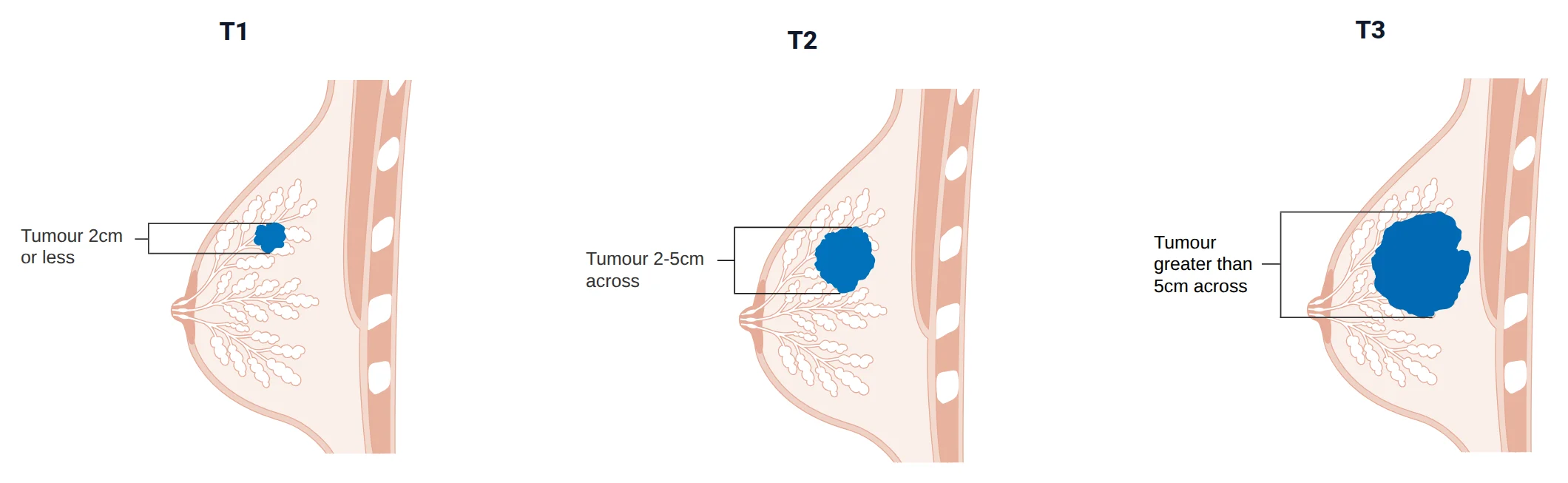
Stages 0 to 4
| Stage | Meaning |
|---|---|
| Stage 0 | Abnormal cells are present but have not spread into nearby tissue (carcinoma in situ or CIS); CIS is not cancer but may become cancer |
| Stages 1, 2 and 3 | Cancer is present; the higher the number, the bigger the tumour and the more it has spread into nearby tissue |
| Stage 4 | The cancer has spread to distant parts of the body |
Further letters and numbers give more detail; for example, stage 2 prostate cancer may be divided into 2A, 2B or 2C [1].
Cancer registries usually use a simpler classification: in situ, localised (confined to where it started), regional (spread to nearby lymph nodes, tissues or organs), distant (spread to distant parts of the body) and unknown [1]. Survival statistics are often reported on this basis.
| Cancer | Only in the organ where it started | Reached lymph nodes or nearby tissue | Spread to distant organs |
|---|---|---|---|
| All cancers | 9 | 7 | 3 to 4 |
| Breast (women) | Almost all | 9 | 3 |
| Prostate | Almost all | Almost all | 4 |
| Skin melanoma | Almost all | 8 | 3 to 4 |
| Ovary | 9 | 7 | 3 |
| Colon and rectum | 9 | 7 | 1 to 2 |
| Stomach | 8 | 4 | Less than 1 |
| Lung | 6 to 7 | 4 | 1 |
| Liver | 4 | 1 | Less than 1 |
These numbers are averages of thousands of past patients, and treatments have improved since then; they cannot be used to predict what will happen to one person [4].
How is stage different from grade?
The stage refers to the size of the tumour and how far it has spread, whereas the grade describes how normal or abnormal the cancer cells look under a microscope. The more normal the cells look, the more slowly the cancer usually grows. Most tumours are described as grade 1 (well differentiated, low grade) to grade 3 and 4 (poorly differentiated or undifferentiated, high grade), and the doctor considers the grade together with the stage, the tumour's genetic features, age and general health when planning treatment [3].
Related questions
Does stage 4 mean there is no treatment?
No. There is treatment for most metastatic cancers; the aim is often to control the disease, and some people live for years with controlled disease [5].
If the cancer comes back or spreads, does the stage change?
How is the stage of a cancer determined?
With an examination, imaging, laboratory tests and sometimes a biopsy; the result is usually recorded in the pathology report [1].
References
6 referencesShow all references, 2 with a study cardClose the reference list
Numbers in the text, such as [1], refer to these sources. Sources with a “Study card” button are summarised in the site’s evidence library.
- 1
- 2The Eighth Edition AJCC Cancer Staging Manual: Continuing to build a bridge from a population‐based to a more “personalized” approach to cancer staging
- 3
- 4Cancer statistics, 2026
- 5Metastatic Cancer: When Cancer Spreads
- 6Recurrent Cancer: When Cancer Comes Back
This page is based on reputable scientific sources and was last updated on 28 October 2026. The content of this website is for educational and informational purposes only and does not replace consultation, diagnosis or treatment by a specialist physician. Consult your treating physician about any treatment decision.
Printed from the website; the full and up-to-date version: https://drdabiri.com/en/questions/cancer-stages/