Metastasis means cancer cells spreading from where they started to distant parts of the body; in many cancers this is "stage 4", and it most often reaches the bones, liver and lungs [1]. Most cancers that have spread can be treated; the aim is often to stop or slow the disease, and some people live for years with spread cancer that is under control [1]. In the United States, the number of people living 5 years with cancer that has spread has roughly doubled from the 1990s to today [2].
Key points
- Cancer cells that have reached a distant site may stay dormant for years and then grow, or never grow at all [1].
- Palliative care (control of pain and symptoms) can be provided at any stage of treatment [1] (Cancer pain).
How does cancer spread?
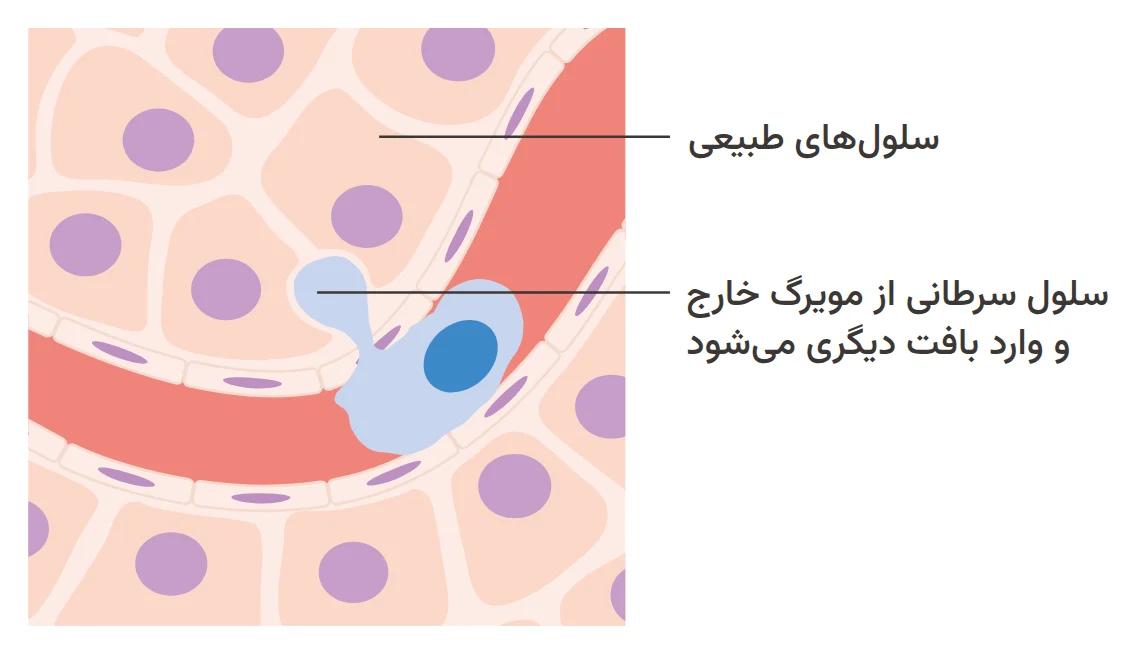
Cancer cells spread through the body in several steps [1]:
- Growing into the nearby normal tissue (invasion)
- Passing through the walls of nearby lymph nodes or blood vessels
- Travelling through the lymphatic system and the bloodstream to other parts of the body
- Stopping in small vessels at a distant site, passing through the vessel wall and entering the surrounding tissue
- Growing in that tissue to form a small tumour
- Making new blood vessels that allow the metastatic tumour to be fed
Most cells that break away from a tumour die along the way; but if conditions are right at every step, some can form a new tumour [1].
| Type of cancer | Main sites of metastasis |
|---|---|
| Breast | Bone, brain, liver, lung |
| Lung | Adrenal gland, bone, brain, liver, the other lung |
| Colon | Liver, lung, peritoneum |
| Prostate | Adrenal gland, bone, liver, lung |
| Melanoma | Bone, brain, liver, lung, skin, muscle |
| Kidney | Adrenal gland, bone, brain, liver, lung |
| Stomach and pancreas | Liver, lung, peritoneum |
| Ovary | Liver, lung, peritoneum |
| Bladder and thyroid | Bone, liver, lung |
Symptoms of metastasis
Cancer that has spread does not always cause symptoms. When it does, they depend on the size and location of the new tumours [1]:
- Bone: pain and fractures
- Brain: headache, seizures or dizziness
- Lung: shortness of breath
- Liver: jaundice or swelling of the abdomen
Can metastasis be treated?
Most cancers that have spread can be treated, and the choice of treatment depends on the type of the original cancer, where it has spread, previous treatments and general health. The aim is often to control the disease, and some treatments improve life by easing symptoms [1]. Two examples of progress:
- When there are only a few spots of spread: in a study of 99 patients with 1 to 5 metastases, adding precise radiotherapy to all of them more than doubled the number of people alive at 5 years [3].
- Immunotherapy in melanoma: among patients who were alive and progression-free 3 years after starting immunotherapy, almost none had died of melanoma after 10 years [4].
| Cancer | About 25 years ago | Today |
|---|---|---|
| All cancers | Less than 2 | 3 to 4 |
| Prostate | 3 | 4 |
| Skin melanoma | Less than 2 | 3 to 4 |
| Breast (women) | 2 to 3 | 3 |
| Ovary | 3 | 3 |
| Rectum | Less than 1 | 2 |
| Colon and rectum | Less than 1 | 1 to 2 |
| Lung | Almost none | 1 |
| Stomach | Almost none | Less than 1 |
These numbers are averages of thousands of patients, do not predict one person's future, and do not yet include newer treatments.
Related questions
Is breast cancer that has spread to the lung lung cancer?
No. The spread cells look like the original cancer under the microscope; this is why the disease is called "metastatic breast cancer" and is treated as stage 4 breast cancer [1].
What if it is not known where the cancer started?
Sometimes doctors cannot find out where a cancer that has spread started; this is called "cancer of unknown primary" [1].
Scientific evidence
Key studies in the evidence library
1 itemFinal, 10-Year Outcomes with Nivolumab plus Ipilimumab in Advanced Melanoma
Related cancer types
Related questions
References
5 referencesShow all references, 3 with a study cardClose the reference list
Numbers in the text, such as [1], refer to these sources. Sources with a “Study card” button are summarised in the site’s evidence library.
- 1
- 2Cancer statistics, 2026
- 3Stereotactic Ablative Radiotherapy for the Comprehensive Treatment of Oligometastatic Cancers: Long-Term Results of the SABR-COMET Phase II Randomized Trial
- 4Final, 10-Year Outcomes with Nivolumab plus Ipilimumab in Advanced Melanoma
- 5Common Cancer Myths and Misconceptions
This page is based on reputable scientific sources and was last updated on 28 October 2026. The content of this website is for educational and informational purposes only and does not replace consultation, diagnosis or treatment by a specialist physician. Consult your treating physician about any treatment decision.
Printed from the website; the full and up-to-date version: https://drdabiri.com/en/questions/what-is-metastasis/