Glioblastoma is the most common malignant brain tumour, and in the World Health Organization classification it is "grade 4", the fastest-growing group [1, 3]. Standard treatment is surgery to remove as much of the tumour as can be removed safely, followed by about 6 weeks of radiotherapy with temozolomide tablets and then 6 cycles of the tablets [4, 9]. With today's treatments the disease usually does not go away completely and often comes back [2, 7]; but treatment helps people live longer: in the main study, about 1 in 4 patients lived more than 2 years and about 1 in 10 lived more than 5 years [4, 5].
Key points
- Glioblastoma is the most common malignant brain tumour: about half of the malignant tumours that start in the brain itself are of this type, and it is more common in men [3].
- Grade 4 means a fast-growing tumour. Today the name "glioblastoma" is used only for tumours without a mutation in the IDH gene; a grade 4 tumour with this mutation is called "grade 4 astrocytoma" and has a better outlook, meaning patients usually live longer [1, 2, 11].
- Standard treatment: surgery, then radiotherapy with temozolomide tablets, then the tablets on their own [4, 9]; a cap-like device that delivers a weak electric field to the tumour also helped people live longer [7].
- The MGMT test matters: when this gene is "switched off" (methylated) in the tumour, temozolomide tablets help most [6].
- In older people, shorter radiotherapy (about 3 weeks) with the tablets helped people live longer than radiotherapy alone [8].
- The outlook is serious, but it is not the same for everyone: younger age, better general health, removal of more of the tumour and a switched-off MGMT gene are linked with longer survival [2, 5, 6].
What is glioblastoma, or a grade 4 brain tumour?
Glioblastoma is a tumour that starts in the support cells of the brain (glial cells) and spreads into the healthy tissue around it [1, 2]. Doctors grade brain tumours from 1 to 4; "grade 4" means the tumour is fast-growing and aggressive, both under the microscope and in its genetic changes [1]. Read: What is cancer grade? Grade versus stage
Since 2021, brain tumours have been diagnosed from both the appearance of the cells and the genetic changes in the tumour. The name "glioblastoma" is used only for gliomas without a mutation in the IDH gene; if certain genetic changes are found, the tumour counts as a glioblastoma even when it looks slow-growing under the microscope [1, 2]. The disease is seen mostly in middle-aged and older people [11]. In most patients no clear cause is found; only occasionally do inherited family conditions or previous radiotherapy to the head play a part, and there is no known way to prevent it [2]. To read about mobile phones, see Do mobile phones cause cancer?
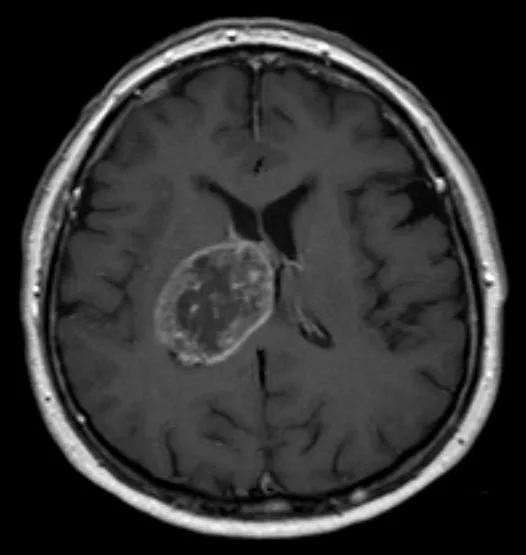 (full-size image, opens in a new tab)
What are the symptoms of glioblastoma?
The symptoms depend on where the tumour is. Because glioblastoma grows quickly, symptoms usually appear or get worse only a few weeks before diagnosis [2]. Common symptoms [2]:
- a new seizure in adulthood
- weakness or numbness on one side of the body, or new difficulty speaking or seeing
- changes in memory, thinking, behaviour or personality
- headache and nausea caused by raised pressure inside the head
In the year before diagnosis, most patients have only vague symptoms such as tiredness or headache [2]. Most headaches have a simple cause; to find out which symptoms you should show a doctor promptly, read: What are the symptoms of a brain tumour?
How is glioblastoma diagnosed?
The main way to find the tumour is an MRI scan of the brain with contrast dye [2]. The diagnosis is confirmed by examining tumour tissue removed during surgery or by a needle biopsy; genetic tests such as IDH and MGMT are done on the same sample [2]. Before surgery, steroid medicines may be given to reduce the swelling around the tumour and its symptoms [2].
Glioblastoma treatment
- 1
Surgery
The brain surgeon removes as much of the tumour as can be removed safely. Preserving the patient's abilities matters more than removing the whole tumour, because surgery alone does not get rid of this tumour [2]. If surgery is not safe, a needle biopsy is done [2]. It is best to have surgery in a centre that carries out a large number of brain tumour operations [2].
- 2
Radiotherapy with temozolomide tablets
About 6 weeks of radiotherapy, 5 days a week, with temozolomide tablets every day; then 6 cycles of the tablets, each cycle 5 days in every 28 days [4, 9]. In the main study, adding the tablets to radiotherapy more than doubled the number of patients who lived more than 2 years [4]. Details: The Stupp regimen and Temozolomide (Temodal).
- 3
The electric-field device
A portable device that sends a weak electric field to the tumour through four pads stuck to the shaved scalp, stopping cancer cells from dividing; it needs to be worn for at least 18 hours a day [7]. Adding it to the tablets in the period after radiotherapy helped people live longer; the most common side effect was mild to moderate skin irritation under the pads, seen in about half of patients [7]. Guidelines recommend that this treatment be considered [9].
- 4
Treatment for older people or patients who are not in good general health
In patients aged 65 or over, shorter radiotherapy (about 3 weeks) with temozolomide tablets helped people live longer than radiotherapy alone, without worsening quality of life; the benefit was greater in tumours with a switched-off MGMT gene [8]. If the patient is older or their general health does not allow intensive treatment, radiotherapy alone (when MGMT is not switched off), temozolomide tablets alone (when MGMT is switched off) or supportive care alone to keep the patient comfortable are all reasonable choices [2, 9]. It is best for this decision to be made by the patient, family and care team together, based on the patient's own wishes. A guide for families: A guide for family members and caregivers of people with cancer.
Is glioblastoma curable? Is it fatal? Life expectancy
Glioblastoma is a serious illness. With today's treatments it usually does not go away completely, and it often comes back, even after full treatment [2, 7]. But treatment helps people live longer:
- In the main study, with surgery and radiotherapy plus temozolomide tablets, about 1 in 4 patients lived more than 2 years, more than twice as many as with radiotherapy alone [4].
- After 5 years, about 1 in 10 of those who had the tablets were alive; most of these people had more favourable circumstances [5].
- Patients whose tumour had a switched-off MGMT gene benefited most from the tablets and lived longer [6].
- Adding the electric-field device to the tablets also helped people live longer [7].
These figures come from large groups and cannot predict exactly what will happen to any one person. Younger age, better general health, removal of more of the tumour and a switched-off MGMT gene are linked with longer survival [2, 5, 6]. Read more: What do cancer survival rates and life expectancy really mean?
How is a grade 4 IDH-mutant astrocytoma different?
Some grade 4 tumours have a mutation in the IDH gene. These tumours used to be called "IDH-mutant glioblastoma", but they are now called "astrocytoma, IDH-mutant, grade 4", because biologically they are a different disease [1, 2]:
- They are usually seen in younger people; in one study, patients with the mutation were typically around 30 years old and patients without it around 60 [11].
- They have a better outlook: in the same study, patients with the mutation lived about twice as long [11].
- They are usually treated with radiotherapy and temozolomide tablets, as for glioblastoma or grade 3 astrocytoma [9].
Read more about IDH-mutant gliomas: Brain tumours: IDH-mutant gliomas.
What happens if glioblastoma comes back?
Most often the tumour comes back in the same place as before [7]. The choice of treatment depends on the patient's condition, where the tumour has come back and the treatments given before [2]:
- Another operation is always considered; it helps most when all of the visible tumour can be removed [2].
- Lomustine tablets, another chemotherapy medicine, are one of the main treatments at this stage [2, 10]. Adding the medicine bevacizumab to lomustine held back tumour growth for a while but did not help people live longer [10].
- Temozolomide tablets again, or radiotherapy (if radiotherapy has not been given before) are also options [2].
At this stage, supportive and palliative care to control symptoms and keep the patient comfortable matters a great deal.
New treatments and clinical trials
Researchers are studying new treatments such as immunotherapy, cancer-killing viruses and targeted medicines; these treatments are not yet part of standard care [12]. So far, in large studies, the immunotherapy medicine nivolumab has not helped people with glioblastoma live longer than usual treatment [2]. The new naming of tumours in 2021 helps similar patients to be studied together in trials [12]. If you are interested, ask your doctor whether there is a suitable clinical trial for you.
When should I call my doctor?
If you or someone you love has glioblastoma, contact the care team the same day in these situations:
- a new or worsening headache, or nausea and vomiting [2]
- new weakness, new difficulty speaking or seeing, or confusion and changes in behaviour [2]
- a fever, or unusual bleeding or bruising while taking temozolomide tablets; these tablets lower the platelets and white blood cells [2]
A seizure that goes on or keeps repeating, or severe drowsiness in which the patient can hardly be woken: call your local emergency number straight away. Read: Fever and warning signs during chemotherapy.
Frequently asked questions
What does a grade 4 brain tumour mean?
Is glioblastoma treatable?
Yes, it can be treated, and treatment helps people live longer, but with today's treatments it usually does not go away completely [2, 4, 5]. Standard treatment is surgery, radiotherapy with temozolomide tablets and then the tablets on their own [9].
Is brain cancer fatal? What is the survival rate?
It depends on the type of tumour. In the United States, about 1 in 3 people with a malignant brain tumour are alive 5 years later [3]; this figure is lower for glioblastoma and higher for many other tumours [3, 5]. Your doctor can give you a clearer picture based on the type of tumour, its genetic changes and your general health.
Is a grade 4 glioma different from glioblastoma?
"Glioma" is the general name for a group of brain tumours. A grade 4 glioma without an IDH mutation is called glioblastoma; a grade 4 glioma with an IDH mutation is a grade 4 astrocytoma, which is usually seen in younger people and has a better outlook [1, 2, 11].
What are the side effects of temozolomide tablets?
The most important side effect is a fall in blood cells, especially platelets; this is why regular blood tests and liver checks are needed [2]. Read the details on the Temozolomide (Temodal) page.
Is glioblastoma hereditary?
Most cases are not inherited. Only in a few rare inherited conditions, such as neurofibromatosis type 1, Li–Fraumeni syndrome and Lynch syndrome, is the risk of glioma higher; genetic counselling is recommended in these families [2].
Diagnostic criteria and treatment evidence (for doctors)
For physicians
WHO CNS5 definition. Glioblastoma, IDH-wildtype, CNS WHO grade 4: a diffuse astrocytic glioma without IDH or H3 mutations, with microvascular proliferation or necrosis, or a TERT promoter mutation, EGFR amplification or a +7/−10 signature [1, 2]. In IDH-mutant astrocytoma, homozygous CDKN2A/B deletion marks grade 4 [2]. MGMT promoter methylation testing is recommended, especially in older or frail patients, to guide decisions on temozolomide [2].
Key evidence. EORTC-NCIC (573 patients, median age 56): radiotherapy 60 Gy in 30 fractions with temozolomide 75 mg/m² daily, then 6 cycles of 150–200 mg/m² on days 1–5 every 28 days; median survival 14.6 vs 12.1 months (HR 0.63), 2-year survival 26.5% vs 10.4% [4]; 5-year survival 9.8% vs 1.9% [5]. MGMT methylated in 45% of 206 samples, an independent prognostic factor (HR 0.45); in methylated tumours median survival 21.7 vs 15.3 months, and in unmethylated tumours a small, non-significant difference [6]. EF-14 (695 patients after chemoradiotherapy): TTFields (at least 18 hours a day) with maintenance temozolomide, median PFS 6.7 vs 4.0 months and OS 20.9 vs 16.0 months (HR 0.63 for both); mild to moderate skin toxicity 52% [7]. CCTG CE.6 (562 patients aged 65 and over, median age 73): 40 Gy in 15 fractions with or without temozolomide, OS 9.3 vs 7.6 months (HR 0.67); MGMT methylated 13.5 vs 7.7 months (HR 0.53), unmethylated 10.0 vs 7.9 months (HR 0.75; P = .055) [8]. EORTC 26101 (437 patients at first progression): lomustine plus bevacizumab vs lomustine, OS 9.1 vs 8.6 months (HR 0.95), PFS 4.2 vs 1.5 months; grade 3–5 adverse events 63.6% vs 38.1% [10]. IDH-mutant glioblastoma (previous classification): median survival 31 vs 15 months and median age 32 vs 59 years [11].
Guideline recommendations. ASCO-SNO 2022: concurrent chemoradiotherapy followed by 6 months of adjuvant temozolomide; TTFields should be considered; bevacizumab is not recommended; when the benefits of 6-week radiotherapy may not outweigh the harms, hypofractionated radiotherapy with temozolomide is reasonable; at ≥ 60 to ≥ 70 years with poor performance status or when toxicity or prognosis is a concern: best supportive care alone, radiotherapy alone (MGMT unmethylated) or temozolomide alone (MGMT methylated). Grade 4 IDH-mutant astrocytoma may follow the recommendations for grade 3 astrocytoma or for glioblastoma [9]. EANO: hypofractionated radiotherapy (e.g. 40 Gy in 15 fractions) over 65–70 years or with KPS below 70; at recurrence, second surgery should always be considered, and options are a nitrosourea, temozolomide rechallenge, bevacizumab and radiotherapy (if not previously irradiated); nivolumab was not superior to bevacizumab at recurrence nor to temozolomide in newly diagnosed MGMT-unmethylated tumours; primary antiseizure prophylaxis does not reduce the risk of a first seizure [2]. Doses and regimens: Brain tumour treatment regimens and doses and The Stupp regimen.
Scientific evidence
Scientific evidence
9 itemsMGMT Gene Silencing and Benefit from Temozolomide in Glioblastoma
Effects of radiotherapy with concomitant and adjuvant temozolomide versus radiotherapy alone on survival in glioblastoma in a randomised phase III study: 5-year analysis of the EORTC-NCIC trial
Short-Course Radiation plus Temozolomide in Elderly Patients with Glioblastoma
Effect of Tumor-Treating Fields Plus Maintenance Temozolomide vs Maintenance Temozolomide Alone on Survival in Patients With Glioblastoma: A Randomized Clinical Trial
EANO guidelines on the diagnosis and treatment of diffuse gliomas of adulthood
Therapy for Diffuse Astrocytic and Oligodendroglial Tumors in Adults: ASCO-SNO Guideline
Glioblastoma in adults: A Society for Neuro-Oncology (SNO) and European Society of Neuro-Oncology (EANO) consensus review on current management and future directions
Lomustine and Bevacizumab in Progressive Glioblastoma
Radiotherapy plus Concomitant and Adjuvant Temozolomide for Glioblastoma
Related cancer types
References
12 referencesShow all references, 10 with a study cardClose the reference list
Numbers in the text, such as [1], refer to these sources. Sources with a “Study card” button are summarised in the site’s evidence library.
- 1
- 2
- 3
- 4
- 5
- 6
- 7
- 8
- 9
- 10
- 11
- 12Glioblastoma in adults: A Society for Neuro-Oncology (SNO) and European Society of Neuro-Oncology (EANO) consensus review on current management and future directions
This page is based on reputable scientific sources and was last updated on 28 October 2026. The content of this website is for educational and informational purposes only and does not replace consultation, diagnosis or treatment by a specialist physician. Consult your treating physician about any treatment decision.
Printed from the website; the full and up-to-date version: https://drdabiri.com/en/questions/glioblastoma/