The most important symptom of mouth cancer is a mouth ulcer or sore that has not healed after 3 weeks [1, 3]. Other symptoms are a white or red patch on the gums, tongue or inside of the cheek; a lump or thickening on the lip or in the mouth; bleeding, pain or numbness in the mouth; loose teeth or dentures that no longer fit; and a lump in the neck [1, 3]. A persistent sore throat, difficulty swallowing or a hoarse voice that lasts more than 4 weeks may come from cancer of the throat or voice box [2, 10]. Most mouth ulcers have a simple cause; but an ulcer that has been there for more than 3 weeks should be examined by a dentist or doctor, especially if you smoke, use a waterpipe or chewing tobacco, or drink alcohol [3, 4].
Key points
- A mouth ulcer or sore that has not healed after 3 weeks is the most important warning sign of mouth cancer [1, 3].
- A red or white patch that stays in the mouth should be examined; red patches are more dangerous: in a large review, about 1 in every 3 red patches turned into cancer [3, 7].
- Smoking, waterpipe (hookah), smokeless tobacco such as naswar, and alcohol are the main risk factors, and smoking and drinking together raise the risk much more [4, 5, 6].
- Cancer of the tonsils and base of the tongue (the throat) is increasingly linked to the HPV virus, and its first sign is sometimes a lump in the neck [2].
- Checking the mouth in people at high risk saves lives: in a large study, regular mouth examinations lowered deaths from mouth cancer among people who used tobacco or alcohol [8].
Symptoms of mouth and throat cancer
| Symptom | What it is like | What to do |
|---|---|---|
| A mouth ulcer or sore that does not heal | A sore on the lip or inside the mouth that has been there for more than 3 weeks [1, 3] | See a dentist or doctor |
| A white or red patch | On the gums, tongue or lining of the mouth; a red, or red and white, patch is more worrying [1, 3, 7] | An examination and, if needed, a biopsy |
| A lump or thickening | On the lip, gums or inside the mouth [1, 3] | See a doctor as soon as possible |
| Bleeding, pain or numbness | In the lip or mouth [1] | If it continues, see a doctor |
| Loose teeth or dentures that no longer fit | Teeth that have become loose, or dentures that no longer fit well [1] | A dental examination |
| Difficulty chewing, swallowing or moving the tongue or jaw | Or swelling of the jaw [1] | See a doctor to have it checked |
| A persistent sore throat or ear pain | Or a feeling that something is stuck in the throat; it may come from the throat [1, 2] | If it does not go away, see an ear, nose and throat (ENT) specialist |
| A hoarse voice | A voice that has stayed hoarse for more than 4 weeks [10] | An examination of the voice box; sooner if you smoke or have a neck lump [10] |
| A lump in the neck | A persistent lump with no clear cause; sometimes the first sign of throat cancer [2, 3] | See a doctor as soon as possible |
Most of these symptoms have simpler causes such as an ulcer, an infection or a dental problem; this table does not replace an examination. Mouth cancer sometimes causes no symptoms and is found during a routine dental check-up [1].
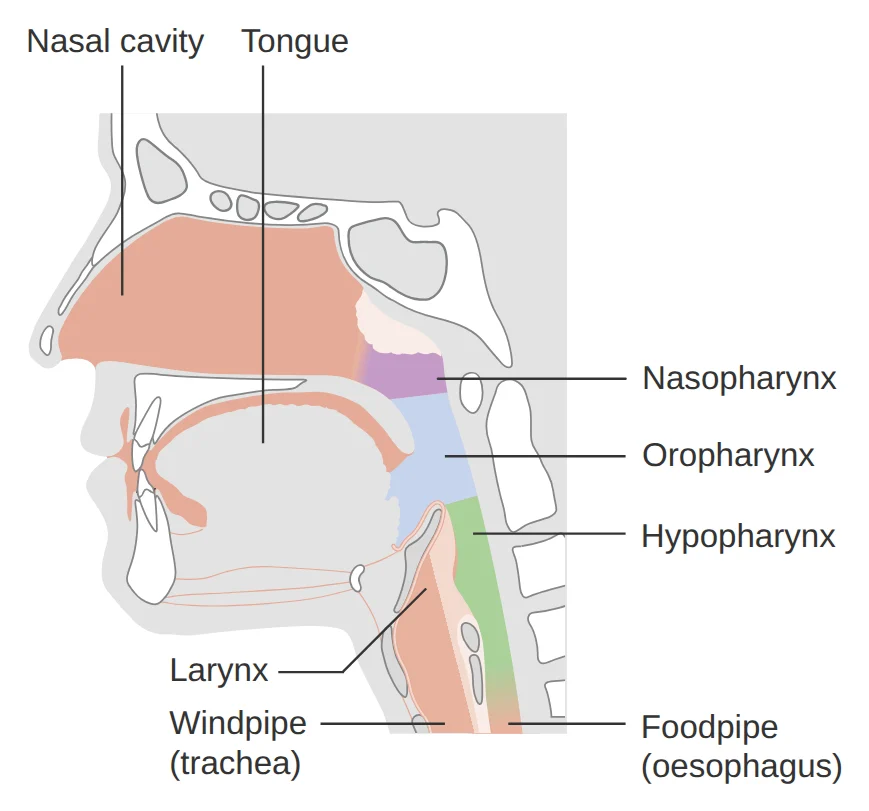
When is a mouth ulcer worrying?
More than 3 weeks
Any mouth ulcer that has been there for more than 3 weeks should be examined, even if it does not hurt [3].
A white or red patch
A white patch that cannot be wiped off (leukoplakia) and especially a red patch (erythroplakia) may be precancerous. In a large review, about 1 in every 10 white patches and 1 in every 3 red patches became cancer over time [7].
The path to diagnosis
- 1
Examination of the mouth and neck
The doctor or dentist looks at and feels the inside of the cheeks and lips, the gums, the roof and floor of the mouth and every surface of the tongue, and checks the neck for swollen lymph nodes [1].
- 2
- 3
Biopsy
Only removing a small piece of the ulcer, patch or lump and looking at it under a microscope confirms the diagnosis [1]. If you are worried about a biopsy, read Does a biopsy make cancer spread?
- 4
Imaging and staging
A CT scan, MRI or PET scan shows how far the tumour has grown [1]. In throat cancer the sample is also tested for HPV, because this changes the outlook and the treatment [2]. Read more: head and neck cancers.
When should I call my doctor?
See a dentist or doctor if you have a mouth ulcer or sore that has not healed after 3 weeks, a red or white patch, a lump on the lip or in the mouth, or a lump in the neck that does not go away [3]. A hoarse voice that has lasted more than 4 weeks should also be examined; if you smoke or have a neck lump, do not wait [10].
Difficulty breathing, a noisy or whistling sound when breathing in, heavy bleeding from the mouth, or being unable to swallow water need urgent care at an emergency department.
Who is at higher risk?
Smoking and waterpipe
Naswar and other smokeless tobacco
Naswar is a type of smokeless tobacco that is held in the mouth, in direct contact with its lining. In a review of studies from Pakistan, the risk of mouth cancer in people who had used naswar was about 12 times higher [5].
Alcohol
Alcohol, especially together with smoking, raises the risk a great deal; the effect of the two together is greater than the sum of each on its own. In a large analysis, about 2 in every 3 mouth cancers were linked to tobacco or alcohol [4].
The HPV virus
The HPV virus is an important cause of cancer of the tonsils and base of the tongue, and the number of these cancers is rising; HPV-related cancer responds better to treatment [2]. Read more: the HPV vaccine and Is cancer contagious?
Opium
Opium use, whether smoked or eaten, causes cancer and raises the risk of cancer of the voice box [9]. Read more: Does opium cause cancer?
Sun exposure and being male
Long-term sun exposure raises the risk of lip cancer, and lip and mouth cancer are more common in men [1].
Stopping smoking, waterpipe, chewing tobacco and alcohol completely is the most important step, because most mouth and throat cancers are linked to them [4] (How much does stopping smoking lower cancer risk?). If you use any form of tobacco, ask your dentist to look carefully inside your mouth at every check-up; in a large study in India, regular mouth examinations lowered deaths from mouth cancer among people who used tobacco and alcohol [8].
Frequently asked questions
My mouth ulcer is not healing; could it be cancer?
Most mouth ulcers have a simple cause, such as an ordinary ulcer, a bite or a sharp tooth, and heal. But an ulcer that has been there for more than 3 weeks should be examined; this is the limit a UK medical guideline sets for urgent referral [3].
Does mouth cancer hurt?
Is a white patch in the mouth dangerous?
Can a waterpipe (hookah) cause mouth cancer?
Yes. A waterpipe also burns tobacco, and in a large review it was linked to about a 4-fold higher risk of mouth cancer and a higher risk of lung cancer [6]. Read more: Does hookah smoking cause cancer?
How dangerous is naswar (smokeless tobacco)?
Naswar is a type of tobacco held in the mouth. In a review of studies from Pakistan, the risk of mouth cancer in naswar users was about 12 times higher, and about 4 in every 10 mouth cancers there were attributed to naswar [5].
Is mouth cancer curable?
Early mouth cancer is treated with surgery or radiotherapy, and the outcome depends above all on the stage of the cancer [1]. That is why finding it early matters: in a large study, regular mouth examinations in people at high risk lowered deaths from mouth cancer [8]. See the treatments in the guide to head and neck cancers.
Are mouth sores during chemotherapy a sign of cancer?
Sores that appear during chemotherapy or radiotherapy are a side effect of the treatment itself, not a sign of a new cancer; read how to care for them in mouth sores (mucositis).
Referral criteria and clinical points (for physicians)
For physicians
NICE NG12. Consider a suspected cancer pathway referral (diagnosis or exclusion within 28 days) for oral cancer in people with unexplained ulceration in the oral cavity lasting more than 3 weeks or a persistent unexplained lump in the neck; an urgent referral (within 2 weeks) for assessment by a dentist in people with a lump on the lip or in the oral cavity, or a red or red and white patch consistent with erythroplakia or erythroleukoplakia; and a suspected cancer pathway referral by the dentist if the findings are consistent with oral cancer or erythroplakia. Laryngeal cancer: people aged 45 and over with persistent unexplained hoarseness or an unexplained lump in the neck [3].
Dysphonia (AAO-HNSF guideline, 2018). Perform laryngoscopy, or refer, when dysphonia fails to resolve or improve within 4 weeks, or irrespective of duration if a serious underlying cause is suspected; a history of tobacco use, a neck mass, respiratory distress or stridor, and recent surgery or intubation involving the head, neck or chest call for expedited evaluation [10].
Oral potentially malignant disorders. In a meta-analysis of 92 studies, the overall malignant transformation rate was 7.9%: erythroplakia 33.1%, leukoplakia 9.5%, proliferative verrucous leukoplakia 49.5%, oral submucous fibrosis 5.2% and lichen planus 1.4%; moderate or severe dysplasia carried a higher risk than mild dysplasia (OR 2.4) [7].
Risk factors. In the INHANCE pooled analysis (11,221 cases and 16,168 controls), the joint effect of tobacco and alcohol was greater than multiplicative (psi 2.15), and their population attributable risk was 64% for oral cavity, 72% for pharyngeal and 89% for laryngeal cancer [4]. Naswar in Pakistan: meta-analysis OR 11.8 (8.4 to 16.4) and population attributable fraction 44% [5]. Waterpipe: OR for oral cancer 4.17 (2.53 to 6.89) [6]. Opium consumption (IARC Group 1): sufficient evidence for laryngeal cancer and limited evidence for pharyngeal cancer [9].
Oral examination in high-risk people. In the Kerala cluster-randomised trial (three rounds of oral visual inspection at 3-year intervals), oral cancer mortality was not significantly reduced in the whole population (RR 0.79; 0.51 to 1.22) but was 34% lower among tobacco or alcohol users (RR 0.66; 0.45 to 0.95) [8]. In users of tobacco (including chewing tobacco and waterpipe) and alcohol, make a careful examination of the oral mucosa and palpation of the neck part of every visit.
Scientific evidence
Scientific evidence
2 itemsInteraction between Tobacco and Alcohol Use and the Risk of Head and Neck Cancer: Pooled Analysis in the International Head and Neck Cancer Epidemiology Consortium
Carcinogenicity of opium consumption
Related cancer types
Related questions
References
10 referencesShow all references, 2 with a study cardClose the reference list
Numbers in the text, such as [1], refer to these sources. Sources with a “Study card” button are summarised in the site’s evidence library.
- 1
- 2
- 3
- 4
- 5
- 6
- 7
- 8
- 9Carcinogenicity of opium consumption
- 10
This page is based on reputable scientific sources and was last updated on 28 October 2026. The content of this website is for educational and informational purposes only and does not replace consultation, diagnosis or treatment by a specialist physician. Consult your treating physician about any treatment decision.
Printed from the website; the full and up-to-date version: https://drdabiri.com/en/questions/symptoms-of-mouth-cancer/