Key points
- Small fragments of tumour DNA (ctDNA) are found in the blood; a blood test can show whether cancer cells are left in the body after surgery [8].
- In bowel cancer, if this test is positive after surgery, the chance of the cancer coming back is much higher [4, 5].
- In a large study of stage 2 bowel cancer, deciding based on this test almost halved chemotherapy without more relapses [1, 2].
- In bladder cancer, giving immunotherapy only to patients whose test became positive lengthened their lives [6].
- But not every approach based on this test has worked; it should not yet replace the doctor's decision on its own [3, 9].
- Overall survival: how long patients lived.
- Progression-free survival: how long the disease did not get worse.
- Disease-free or event-free survival: how long the disease did not come back after treatment.
- Median: the number that half of patients were above and half below; for example, "a median of 10 months" means that in half of patients the disease stayed under control for at least 10 months.
- Phase 3: a large, careful study comparing a new drug with the usual treatment; the basis of most approvals.
Talk to your doctor about what this result means for you.
What are liquid biopsy and ctDNA?
After complete surgery for a tumour, the doctor has to decide whether the patient needs chemotherapy or other adjuvant treatment. This decision has traditionally been based on pathological staging; but staging alone cannot show exactly who really has cancer cells left. For example, after surgery for bowel cancer, about 15 to 20 percent of stage II patients and 30 to 40 percent of stage III patients relapse [8]. As a result, many patients receive chemotherapy they did not need, while others relapse despite treatment.
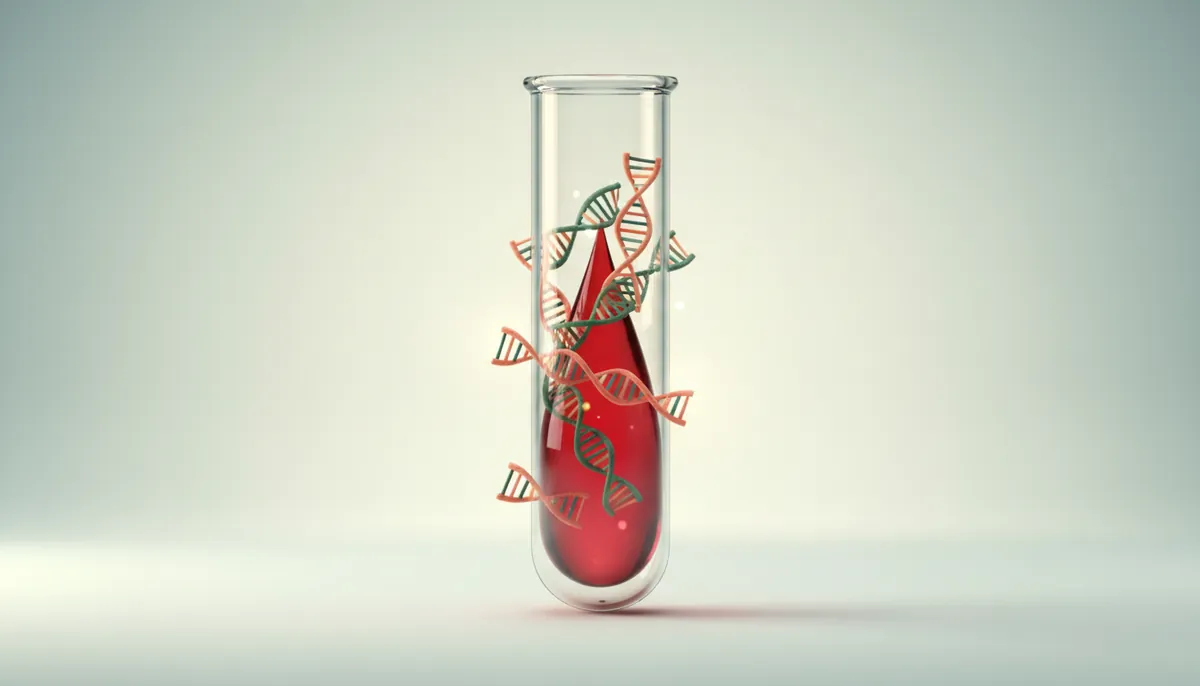
Dying cancer cells release small fragments of their DNA into the bloodstream, called circulating tumour DNA (ctDNA). Because ctDNA clears from the blood within hours of complete removal of the tumour, its persistence after surgery is a sign of microscopic disease left behind; this is called molecular residual disease (MRD) [8].
How is the ctDNA test done?
The steps in using ctDNA in treatment decisions
- 1
- 2
Genetic analysis
In the "tumour-informed" approach, the specific mutations of the patient's tumour are identified first and then searched for in the blood; "tumour-agnostic" approaches work without the need for tumour tissue [9].
- 3
- 4
What did the studies show?
For physicians
Stage II colon cancer: the DYNAMIC trial
In this randomised trial, 455 patients were divided into two groups: in 302, the decision about chemotherapy was based on ctDNA (only ctDNA-positive patients received chemotherapy), and in 153 on standard clinical and pathological criteria. Adjuvant chemotherapy was given to only 15% of patients in the ctDNA group versus 28% in the standard group, and 2-year recurrence-free survival was 93.5% versus 92.4%, which was statistically "non-inferior" [1]. At five-year follow-up, recurrence-free survival (88% vs 87%) and overall survival (93.8% vs 93.3%) remained similar [2].
Stage III colon cancer: the DYNAMIC-III trial
In this phase 2/3 trial with 968 evaluable patients, 72.5% of patients were ctDNA-negative after surgery. Three-year recurrence-free survival was 87% in ctDNA-negative and 49% in ctDNA-positive patients. De-escalating treatment in ctDNA-negative patients reduced oxaliplatin use and hospital admissions, but recurrence-free survival was slightly lower (85.3% vs 88.1%) and the non-inferiority criterion was not met. Escalating chemotherapy in ctDNA-positive patients did not improve the outcome either [3].
Bladder cancer: the IMvigor011 trial
In this double-blind phase 3 trial, 761 patients were monitored regularly for ctDNA after removal of the bladder. The 250 patients who became ctDNA-positive were randomised to atezolizumab or placebo. Median disease-free survival was 9.9 months versus 4.8 months and median overall survival 32.8 months versus 21.1 months. Patients who stayed persistently ctDNA-negative had 88% disease-free survival at two years without adjuvant treatment [6].
Advanced breast cancer: the SERENA-6 trial
In patients with ER-positive, HER2-negative advanced breast cancer on an aromatase inhibitor and a CDK4/6 inhibitor, the blood was checked every 2 to 3 months for an ESR1 mutation. Patients in whom the mutation appeared in the blood but who had no progression on imaging yet were randomised to switch to camizestrant or continue their previous treatment. Median progression-free survival was 16.0 months versus 9.2 months [7].
The ctDNA test is a powerful tool for estimating the risk of relapse, and in some situations, such as stage II colon cancer, it can help some patients avoid unnecessary chemotherapy and its side effects [1, 2]. However, a negative result does not mean "definitely cured", and a positive result does not decide the type of treatment on its own [3, 9]. Always talk to your oncologist about having this test and what its result means, and do not change the recommended treatment without your doctor's advice.
Limitations and open questions
- Prediction is not the same as treatment: this test shows well who is at higher risk of the cancer coming back, but it is not always clear yet that changing treatment based on it improves the outcome [3, 8].
- Adding more chemotherapy in people whose test was positive did not help; they need new treatments [3].
- It is not always accurate: some tumours release little DNA into the blood, and changes in blood cells with ageing can also mislead the result [9].
- It does not replace usual follow-up and should not decide on its own whether to reduce or increase treatment [9].
- In breast cancer too, follow-up with this test still needs more evaluation [10].
For physicians
- Prognosis is not the same as therapeutic utility: that ctDNA predicts relapse well does not necessarily mean that changing treatment based on it improves the outcome; DYNAMIC-III and ALTAIR are examples of this [3, 8].
- Escalation in ctDNA-positive patients: intensifying usual chemotherapy in these patients has shown no benefit, and new treatment strategies are needed for them [3].
- Technical issues: differences in the sensitivity of laboratory methods, tumours that shed little DNA into the blood and interference from mutations related to ageing of blood cells (clonal haematopoiesis) are challenges in interpreting results [9].
- Current recommendations: on present evidence, ctDNA should not routinely replace standard follow-up or, outside proven indications and clinical studies, decide escalation or de-escalation of treatment on its own [9].
- ESR1 monitoring in breast cancer: wide adoption of this strategy needs further validation and harmonisation of test methods [10].
Outlook
This test is gradually moving from the research laboratory into treatment decisions. In bladder cancer it found the patients who benefit from immunotherapy after surgery, and spared the rest extra treatment [6]. In breast cancer too, it can detect a change in the tumour before it shows on imaging so treatment can be changed sooner [7, 10]. Test methods still need to be standardised, and new drugs need to be tested for people whose test is positive [8, 9].
For physicians
ctDNA is turning from a research tool into part of clinical decision-making. The success of IMvigor011 showed that ctDNA can find patients who benefit from adjuvant immunotherapy while sparing low-risk patients unnecessary treatment [6]. SERENA-6 also introduced the idea of switching treatment on "molecular progression" before progression on imaging [7, 10]. Next steps include standardising test methods, designing studies of new drugs for ctDNA-positive patients and validating ctDNA clearance as a surrogate endpoint [8, 9].
Trial details (for physicians)
Show detailsHide
| Study | Phase | Patient population | Main result |
|---|---|---|---|
| DYNAMIC [1, 2] | 2 (randomised) | 455 patients with stage II colon cancer | Chemotherapy reduced from 28% to 15% (relative risk 1.82; 95% confidence interval 1.25 to 2.65); 5-year recurrence-free survival 88% versus 87% |
| DYNAMIC-III [3] | 2/3 | 968 patients with stage III colon cancer | De-escalation: non-inferiority not shown; escalation: no benefit |
| GALAXY [4, 5] | Prospective observational | 2240 patients with resectable bowel cancer | Hazard ratio for disease-free survival 11.99 for positive ctDNA |
| IMvigor011 [6] | 3 (double-blind) | 250 patients with ctDNA-positive muscle-invasive bladder cancer | Improved overall survival with atezolizumab (hazard ratio 0.59) |
| SERENA-6 [7] | 3 | 315 patients with advanced breast cancer and an ESR1 mutation in the blood | Progression-free survival 16.0 versus 9.2 months (hazard ratio 0.44) |
The prognostic value of ctDNA is well established, but its utility for changing treatment has been shown only in some specific situations [9].
- In DYNAMIC, ctDNA clearance at the end of chemotherapy was seen in 35 of 40 treated ctDNA-positive patients (87.5%), and a higher ctDNA burden after surgery was associated with worse recurrence-free survival [2].
- In DYNAMIC-III, de-escalation reduced oxaliplatin use from 88.6% to 34.8% and treatment-related admissions from 13.2% to 8.5%; in ctDNA-positive patients, 2-year recurrence-free survival was 51% with escalated treatment versus 61% with standard treatment. Persistent ctDNA after treatment was associated with 3-year recurrence-free survival of 14% versus 79% [3].
- In GALAXY, sustained ctDNA clearance in response to chemotherapy was associated with 24-month disease-free survival of 89.0% versus 3.3% for transient clearance, and true spontaneous clearance without relapse was only 1.9% (2 of 105) [5].
- The phase 3 ALTAIR trial, which studied trifluridine/tipiracil at molecular relapse, did not meet its primary endpoint (hazard ratio 0.79; p = 0.107) [8].
- In SERENA-6, of 3256 patients screened, 315 were randomised; time to deterioration in patient-reported quality of life was 21.0 months versus 6.4 months [7].
Frequently asked questions
Does a ctDNA test replace CT scans and usual follow-up?
No. It cannot yet replace usual follow-up [9].
If my ctDNA is negative after surgery, does it mean the cancer is completely cured?
A negative result is good news but does not make the risk zero; for example, in one study, even with a negative result, the cancer came back within 3 years in about one in every 8 patients [3].
What should be done if ctDNA is positive?
For which cancers does this test have the most evidence?
Does the ctDNA test need another biopsy of the tumour?
No; the test is done on a blood sample. However, some methods use the tumour tissue removed at surgery to design the test [9].
Scientific evidence
Show detailsHide
Related studies
7 itemsCirculating Tumor DNA Analysis Guiding Adjuvant Therapy in Stage II Colon Cancer
Circulating tumor DNA analysis guiding adjuvant therapy in stage II colon cancer: 5-year outcomes of the randomized DYNAMIC trial
Circulating tumor DNA-guided adjuvant therapy in locally advanced colon cancer: the randomized phase 2/3 DYNAMIC-III trial
Molecular residual disease and efficacy of adjuvant chemotherapy in patients with colorectal cancer
ctDNA-based molecular residual disease and survival in resectable colorectal cancer
ctDNA-Guided Adjuvant Atezolizumab in Muscle-Invasive Bladder Cancer
First-Line Camizestrant for Emerging ESR1-Mutated Advanced Breast Cancer
References
10 referencesShow all references, 10 with a study cardClose the reference list
Numbers in the text, such as [1], refer to these sources. Sources with a “Study card” button are summarised in the site’s evidence library.
- 1
- 2
- 3
- 4
- 5
- 6
- 7
- 8
- 9
- 10
This page is based on reputable scientific sources and was last updated on 28 October 2026. The content of this website is for educational and informational purposes only and does not replace consultation, diagnosis or treatment by a specialist physician. Consult your treating physician about any treatment decision.
Printed from the website; the full and up-to-date version: https://drdabiri.com/en/articles/ctdna-liquid-biopsy/