Cancer is a disease in which some of the body's own cells grow and multiply out of control and can invade nearby tissue and spread to other parts of the body [1]. It is caused by changes in the genes that control how cells grow and divide; these changes mostly build up slowly over many years: sometimes by chance when a cell divides, sometimes because of damage from things such as tobacco smoke or sunlight, and sometimes they are inherited from a parent [1, 4]. Cancer is not one disease; there are more than 100 types, most of them named after the organ where they start [1].
Key points
- Cancer starts in the body's own cells, not from something that enters the body from outside; cancer is not contagious and does not pass from one person to another [1, 5].
- Most cancers happen by chance: gene changes build up over the years; at most about 1 in 10 cancers is due to an inherited gene change [4].
- Age is the most important risk factor: in the United States, half of all cancers are diagnosed at the age of 67 or later [3].
- Cancer is common, but many types can be treated successfully: about 1 in every 5 people worldwide develops cancer during their lifetime [6]; many cancers have a high chance of cure if they are found early and treated properly [2].
What is cancer? A simple explanation
Our body is made up of trillions of cells [1]. Cells are like the body's tiny building blocks. Each cell has an instruction book called DNA, and genes are sections of this book; genes tell the cell when to grow, when to divide and when to die [1, 4].
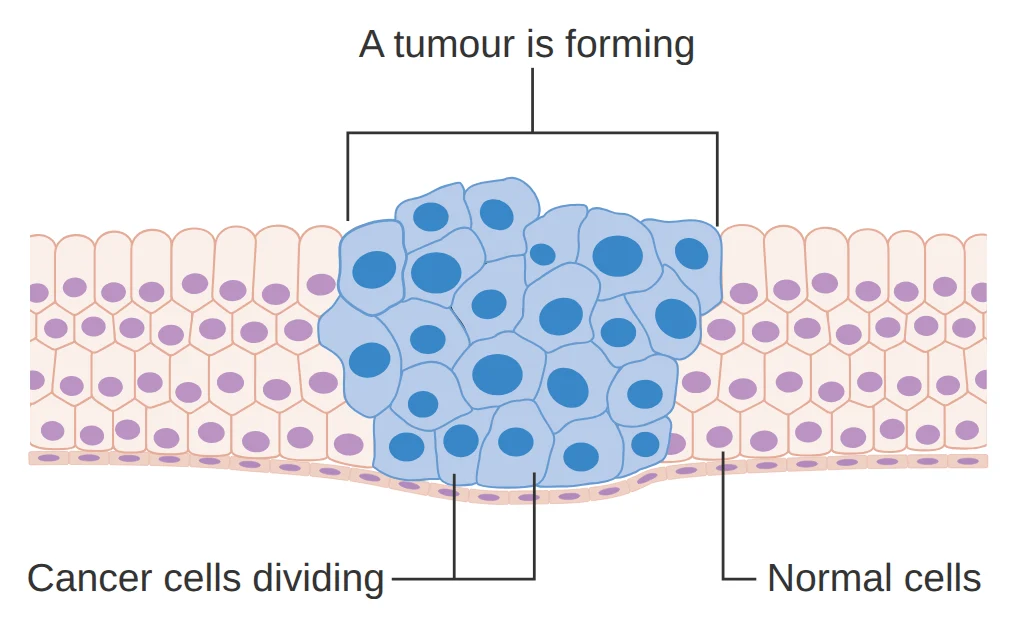
Normally, cells divide only when the body needs new cells, and old or damaged cells die so that new cells can take their place [1]. Cancer starts when this order breaks down: abnormal or damaged cells do not die and divide when they should not [1]. These cells may form a lump called a "tumour" [1].
 (full-size image, opens in a new tab)
How does cancer start?
Cancer is a disease of the genes: it starts from changes in the genes that control how cells grow and divide [1]. These changes happen in three ways [1, 4]:
- A chance mistake: every time a cell divides, its DNA is copied, and sometimes a mistake happens in the copy.
- Damage from outside: chemicals in tobacco smoke, ultraviolet rays from the sun and some viruses such as HPV damage DNA.
- Inheritance: sometimes a gene change that raises the risk of cancer is passed on from a parent.
Most of these changes are not harmful on their own, and the body usually gets rid of damaged cells before they turn into cancer [1, 4]. Cancer usually appears when several changes build up in one cell over many years [4]. This happens step by step and often starts from a pre-cancerous change [2].
Read about the causes and risk factors in detail in What causes cancer?
How is a cancer cell different from a normal cell?
Cancer cells behave in several ways that healthy cells do not [1]:
- They grow without a signal to grow and ignore the signals that tell cells to stop dividing or to die.
- They invade nearby tissue and can travel to other parts of the body; a healthy cell stops growing when it meets other cells.
- They make blood vessels grow towards them to get oxygen and nutrients.
- They hide from the immune system or trick it; normally the immune system gets rid of damaged cells.
These abnormal behaviours are the target of newer treatments [1]: targeted therapy attacks specific gene changes in the cancer cell, and immunotherapy helps the immune system recognise and destroy cancer cells better.
Benign vs malignant tumours: what is the difference?
Not every lump is cancer. A benign tumour does not invade nearby tissue, does not spread and usually does not grow back once removed; but it can sometimes become large, and if it is in a sensitive place such as the brain, it can cause serious problems [1]. A malignant tumour is cancer: it invades nearby tissue and can travel to distant parts of the body [1]. Blood cancers, such as leukaemia, usually do not form lumps [1].
Some changes are not yet cancer but may become cancer if they are not treated, such as "dysplasia" (cells that look abnormal under the microscope) and "carcinoma in situ" (abnormal cells that have not yet grown into the surrounding tissue) [1]. Details: What is the difference between a benign and a malignant tumour?
How does cancer spread in the body?
Cancer cells can break away from the first tumour, travel through the blood or lymph to another place and form a new tumour; this is called "metastasis" [1]. A cancer that has spread keeps the name of the original cancer: breast cancer that has spread to the lung is metastatic breast cancer, not lung cancer [1]. Most deaths from cancer are due to this spread [1, 2]; that is why finding cancer before it spreads matters. Read more: What does metastasis mean, and can it be treated? and What are the stages of cancer?
Types of cancer: carcinoma, sarcoma, leukaemia, lymphoma and myeloma
There are more than 100 types of cancer. Cancers are usually named after the organ where they start, such as lung cancer, and sometimes after the type of cell they come from [1]. These are the main groups:
| Group | Where it starts | Examples |
|---|---|---|
| Carcinoma | Cells that cover the inside and outside surfaces of the body; the most common type of cancer [1] | Most cancers of the breast, bowel and prostate (adenocarcinoma); basal cell and squamous cell carcinoma of the skin [1] |
| Sarcoma | Bone and soft tissues such as muscle, fat, blood vessels and tendons [1] | Osteosarcoma (the most common bone cancer) and liposarcoma [1] |
| Leukaemia (blood cancer) | The blood-forming tissue of the bone marrow; usually does not form a lump [1] | Four common types: acute or chronic, myeloid or lymphoblastic [1] |
| Lymphoma | Lymphocytes, the white blood cells of the immune system, which build up in the lymph nodes [1] | Hodgkin lymphoma and non-Hodgkin lymphoma [1] |
| Multiple myeloma | Plasma cells, a type of immune cell in the bone marrow [1] | Tumours in bones throughout the body [1] |
| Melanoma | The pigment-making cells of the skin [1] | Mostly on the skin; sometimes in the eye [1] |
| Brain and spinal cord tumours | Cells of the brain and spinal cord [1] | Benign or malignant, depending on the cell type [1] |
See the page for each cancer in the site's list of cancers.
Why is cancer more common in older people?
Age is the most important risk factor for cancer [3]. In the United States, half of all cancers are diagnosed at the age of 67 or later [3]. There are two main reasons: gene changes build up over the years, and the body's ability to get rid of damaged cells goes down as we get older [1, 2].
Even so, cancer can happen at any age. Only 1 in 100 cancers occurs in children and teenagers under 20, but some cancers, such as bone cancer, are seen more often at these ages [3]. Read more: Is childhood cancer curable?
How does cancer get into the body? Does it come from outside?
No. Cancer is not a germ that enters the body from outside; it starts in the body's own cells whose genes have changed [1]. Cancer is not contagious and does not pass from one person to another [5]. The only, very rare, exception is an organ or tissue transplant from a donor who has had cancer: about 2 cases in every 10,000 transplants [5].
What can come from outside are harmful agents, not cancer itself: tobacco smoke, ultraviolet rays from the sun, some chemicals and some germs such as HPV, the hepatitis B and C viruses and the bacterium Helicobacter pylori [2]. These germs can pass from person to person, but the cancers they sometimes cause cannot [5]. Read more: Is cancer contagious?
Frequently asked questions
Can you get cancer of the heart?
Yes, but it is very rare. Tumours that start in the heart itself have been found in about 2 in every 10,000 people at autopsy [9]. Some of them are benign, such as myxoma, and usually have a good outcome with surgery; malignant ones, such as sarcomas, progress faster and are harder to treat [9]. Cancer from other organs reaching the heart is more common and has been found at autopsy in about 1 in 10 people with cancer [9].
Is cancer one disease?
Not exactly. "Cancer" is the name for a large group of diseases that can affect any part of the body [2], with more than 100 types [1]. Each type has its own behaviour and treatment, and even two people with the same type of cancer have a different mix of gene changes in their cancer [1]. That is why each person's treatment is chosen according to the type and stage of their own cancer.
What does carcinoma mean?
Carcinoma is the most common type of cancer; it starts in the cells that cover the inside and outside surfaces of the body [1]. "Adenocarcinoma" starts in gland cells (cells that make fluids or mucus), and "squamous cell carcinoma" in flat surface cells [1]. "Carcinoma in situ" has not yet grown into the surrounding tissue and is usually treated so that it does not become cancer [1].
What do neoplasm and malignancy mean?
In medical language, cancer is also called a "malignant tumour" or a "neoplasm" [2]; but "neoplasm" on its own means a lump of abnormal tissue that forms when cells divide more than they should or do not die when they should. Its other name is "tumour", and it can be benign (not cancer) or malignant (cancer) [10]. Only a "malignant" tumour is cancer [1]. "Malignancy" is another word for cancer: a disease in which abnormal cells divide out of control, invade nearby tissue and can spread to other parts of the body through the blood and lymph [11]. If you see these words in a test result or a pathology report, ask your doctor what they mean for you.
If my mother or father had cancer, will I get it too?
Not necessarily. Cancer itself is not inherited; only sometimes a gene change that raises the risk is passed on, and that means a higher risk, not certain illness [4]. At most about 1 in 10 cancers is due to an inherited gene change [4]. Read more: Is cancer hereditary?
Can cancer be cured?
Many cancers have a high chance of cure if they are found early and treated properly [2]. In the United States, the chance of dying from cancer has fallen steadily since the 1990s [5]. See: Can cancer be cured?, Is breast cancer curable? and Is childhood cancer curable?
What are the symptoms of cancer, and when should I see a doctor?
Read about the warning signs of cancer and when to see a doctor in What are the signs and symptoms of cancer? To lower your risk, see Can cancer be prevented?
Basic concepts and global statistics (for doctors)
For physicians
Hallmarks of cancer. Six capabilities acquired during the multistep development of tumours: sustaining proliferative signalling, evading growth suppressors, resisting cell death, enabling replicative immortality, inducing angiogenesis, and activating invasion and metastasis; genome instability and inflammation as enabling characteristics; and two emerging hallmarks: reprogramming of energy metabolism and evading immune destruction; plus the role of the tumour microenvironment [7]. The 2022 update proposed phenotypic plasticity and disrupted differentiation as a discrete hallmark, non-mutational epigenetic reprogramming and polymorphic microbiomes as enabling characteristics, and senescent cells as a component of the tumour microenvironment [8].
Origin of the genetic changes. Replication errors during cell division, environmental carcinogens (tobacco smoke, UV, HPV) and germline variants; up to 10% of cancers may be caused by inherited genetic changes, and the vast majority of cancers arise by chance from the accumulation of changes over time [4].
Global epidemiology. GLOBOCAN 2022: about one in five people develop cancer in their lifetime, and around one in nine men and one in 12 women die from it; lung cancer was the most common, with almost 2.5 million new cases (12.4%), followed by breast (11.6%), colorectal (9.6%), prostate (7.3%) and stomach (4.9%); 35 million new cases are projected for 2050 [6]. WHO estimates for 2024: nearly 10 million deaths (nearly one in six deaths); the most common cancers were lung (2.6 million), breast (2.4 million), colorectal (2.0 million) and prostate (1.5 million cases); about 38% of cancers can be prevented by avoiding risk factors and implementing existing prevention strategies [2].
Age. SEER (2018–2022): incidence under 26 per 100,000 in age groups under 20, about 350 per 100,000 at 45–49 and over 1,000 per 100,000 from 60 onwards; median age at diagnosis 67 years (breast 63, colorectal 66, lung 71 and prostate 68 years). 1% of all cancers, about a quarter of bone cancers and 11% of brain and nervous system cancers are diagnosed before the age of 20 [3].
Cardiac tumours. The autopsy incidence of primary cardiac tumours is reported as 0.02%; benign tumours (myxoma, fibroma) have a good prognosis after surgical resection, primary malignancies (sarcomas, mesothelioma) progress rapidly, and cardiac metastases are found in about 10% of cancer patients at autopsy [9].
References
11 referencesShow all references, 2 with a study cardClose the reference list
Numbers in the text, such as [1], refer to these sources. Sources with a “Study card” button are summarised in the site’s evidence library.
- 1
- 2
- 3
- 4
- 5
- 6Global cancer statistics 2022: GLOBOCAN estimates of incidence and mortality worldwide for 36 cancers in 185 countries
- 7Hallmarks of cancer: the next generation
- 8Hallmarks of Cancer: New Dimensions
- 9
- 10NCI Dictionary of Cancer Terms: neoplasm
- 11NCI Dictionary of Cancer Terms: malignancy
This page is based on reputable scientific sources and was last updated on 28 October 2026. The content of this website is for educational and informational purposes only and does not replace consultation, diagnosis or treatment by a specialist physician. Consult your treating physician about any treatment decision.
Printed from the website; the full and up-to-date version: https://drdabiri.com/en/questions/what-is-cancer/