CAR-T is a type of cell therapy: the patient's own T cells (immune cells) are separated from the blood, a receptor called a CAR is added to them in a laboratory so they can find cancer cells, and after they have multiplied they are given back into a vein once [1]. It is approved for some lymphomas, acute lymphoblastic leukaemia and multiple myeloma [1]. Its main side effects are fever with a strong immune reaction (cytokine release syndrome, or CRS), nervous system problems such as confusion and trouble speaking, long-lasting low blood counts and infections; for this reason patients stay near the treatment centre for at least 2 weeks and do not drive for 2 weeks [1, 2, 4].
Key points
- CAR-T is made from the patient's own cells and is given once; the whole process, from collecting the blood to the infusion, takes about 3 to 5 weeks [1].
- It is used for some lymphomas, acute lymphoblastic leukaemia and multiple myeloma, usually when the disease has come back or has not responded to earlier treatment [1, 2, 3].
- Most patients get some degree of CRS (fever, chills and sometimes low blood pressure); in most patients it is not severe and it can be treated [1, 2, 3].
- Confusion, drowsiness, or trouble speaking or writing are signs of a nervous system side effect and must be reported to the care team straight away [1, 2].
- In some patients the cancer stays away for years: in lymphoma that had not responded to other treatments, about 4 in every 10 people were alive 5 years later [7].
What is CAR-T cell therapy and how does it work?
T cells are a type of white blood cell and among the soldiers of the immune system. In CAR-T therapy, these cells are separated from the patient's own blood and, in a laboratory, given a gene so that they make a receptor called a CAR (chimeric antigen receptor). This receptor helps the T cell find a specific marker on the surface of cancer cells and attack them [1]. The changed cells are multiplied until there are hundreds of millions of them, given back into the patient's vein once, and keep multiplying in the body [1].
Most of today's CAR-T products target one of two markers: CD19 on B cells in lymphoma and leukaemia, or BCMA on multiple myeloma cells [2, 3]. Because each treatment is made from the patient's own cells, making it takes several weeks [1]. CAR-T is a type of immunotherapy that uses T cells [2], but it is different from the usual immunotherapy drugs.
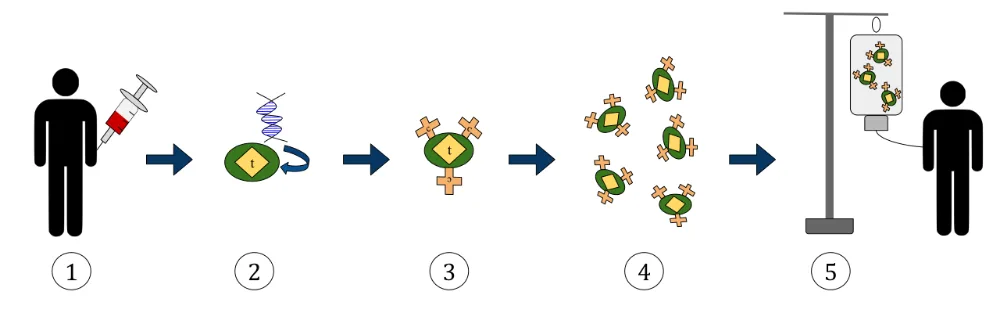 (full-size image, opens in a new tab)
Steps of CAR-T cell therapy: from blood collection to infusion
- 1
- 2
Making the cells in a laboratory
The cells are sent to a manufacturing centre, where the CAR receptor is added and the cells are multiplied. The whole process, from collecting the blood to the infusion, takes about 3 to 5 weeks [1].
- 3
Conditioning chemotherapy
Before the infusion, you get 3 days of chemotherapy to prepare your body for the new cells [2].
- 4
The infusion
The cells are given into a vein; the infusion usually takes less than 30 minutes [2].
- 5
Which cancers is CAR-T cell therapy used for?
CAR-T is approved for these blood cancers [1]:
- Some B-cell lymphomas: large B-cell lymphoma (such as DLBCL), follicular lymphoma and mantle cell lymphoma
- Chronic lymphocytic leukaemia (CLL)
- B-cell acute lymphoblastic leukaemia (ALL) in children, young adults and adults
- Multiple myeloma
It is usually used when the disease has come back or has not responded after the usual treatments. For example [2, 3, 12]:
- In large B-cell lymphoma, when the first treatment has not worked or the disease has come back within a year, or after two or more treatments [2]. Read more: Treatment of large B-cell lymphoma.
- In acute lymphoblastic leukaemia in children and young adults up to 25 years old, when the disease has not responded to treatment or has come back two or more times [12].
- In multiple myeloma, after earlier treatments; one product is used from the first return of the disease, in patients whose disease no longer responds to lenalidomide [3]. See New treatments for multiple myeloma.
Solid tumours. Progress with CAR-T in solid tumours has been slower [1]. The first CAR-T for a solid tumour has been approved in China for stomach cancer with the claudin 18.2 marker [11]; see the news on satri-cel in stomach cancer.
What are the side effects of CAR-T cell therapy?
Cytokine release syndrome (CRS)
When CAR-T cells attack, they release large amounts of inflammatory substances (cytokines). The result is fever, chills, low blood pressure (dizziness), a fast heartbeat and sometimes shortness of breath [1, 2]. With one product in lymphoma, almost 9 in every 10 people got CRS, but only about 1 in 10 got a severe form; it usually starts 2 to 3 days after the infusion [2]. With one myeloma product, it usually started about a week after the infusion [3]. It is treated with the drug tocilizumab and, if needed, steroids [1].
Nervous system side effects (ICANS)
Confusion, marked drowsiness, trouble speaking or writing, shaking (tremor) and, rarely, seizures [1, 2, 5]. With one product in lymphoma, about 3 in every 4 people had some degree of these and about 1 in 4 had a severe form; almost all cases happened in the first 8 weeks [2]. For this reason the care team checks you every day for at least the first 7 days and, as a test, asks you to name a few objects and write a sentence [2, 5].
Low blood counts
Infections and low antibodies
Later nervous system problems in myeloma
With one myeloma CAR-T, movement problems similar to Parkinson's disease occurred in about 3 in every 100 people, usually about 2 months after the infusion; facial weakness or numbness and numbness of the hands and feet have also been reported [3].
A second cancer
Rarely, T-cell cancers have been reported after CAR-T; for this reason lifelong follow-up is recommended [2].
What to expect after CAR-T cell therapy
- The first week: you are checked every day for at least 7 days; you may be admitted to hospital for side effects and discharged once they are under control [2, 4].
- Stay near the treatment centre for at least 2 weeks, so that any side effect can be dealt with quickly [2, 4].
- Do not drive for at least 2 weeks [2, 4].
- Do not miss regular blood tests; if you miss an appointment, rebook it soon [2].
- Tell every doctor you see that you have had CAR-T and show them your patient wallet card [2, 3].
- Do not donate blood, organs or tissue [2].
- Live vaccines are not recommended until your immune system has recovered; ask your doctor about your vaccination plan [2].
For care at home after treatments that weaken the immune system, the guide After discharge from the transplant unit can also help.
CAR-T recovery time: how long does recovery take?
Recovery takes weeks to months. CRS usually settles within the first week or two; with one product it lasted about a week [2]. Nervous system side effects mostly happen in the first 8 weeks and sometimes last longer [2]. Low blood counts may last from several weeks to several months [2, 3].
Healthy B cells gradually return: in one study, 3 years after treatment B cells could be found in the blood again in all the patients who were tested [7]. In children and young adults treated with CAR-T for leukaemia, quality of life improved up to 3 years after treatment [8].
How long does CAR-T cell therapy work? Long-term results
- Large B-cell lymphoma that had not responded to other treatments: 5 years after CAR-T, about 4 in every 10 people were alive, and in about 3 in every 10 the disease was still under control. The researchers say this treatment can cure a group of these patients [7].
- Large B-cell lymphoma that had come back within a year: in a large study, compared with usual treatment (chemotherapy and a stem cell transplant), CAR-T kept the disease under control for longer and more patients stayed alive; 4 years later, more than half of the patients in the CAR-T group were alive [6].
- Acute lymphoblastic leukaemia in children and young adults: 3 years after treatment, about 6 in every 10 were alive; most relapses happened in the first 2 years [8].
- Multiple myeloma: CAR-T kept the disease under control much longer than the usual drug combinations; about 3 times longer in one study [9], and in another the risk of the disease getting worse or death was about three-quarters lower [10]. Even so, in most patients with myeloma the disease comes back after a while [9].
Talk to your doctor about what these results mean for you. Read more: Is lymphoma curable? and Is leukaemia curable?
When should I contact my doctor?
After CAR-T, in any of these situations contact your care team straight away or go to the emergency department [2, 3]:
- A temperature of 38°C or higher, chills or shaking chills
- Shortness of breath, a fast or irregular heartbeat
- Dizziness or light-headedness (a sign of low blood pressure)
- Confusion, drowsiness, memory loss, or trouble speaking, reading or writing, shaking or a seizure [1, 2, 3]
- Severe nausea, vomiting or diarrhoea, or severe tiredness and weakness
- After CAR-T for myeloma: slower movements, a change in handwriting, new apathy or being less talkative, facial numbness or weakness, or numbness and weakness of the hands and feet, even weeks after the infusion [3]
If you go to another hospital, tell them you have had CAR-T [2]. In an emergency, call your local emergency number.
Frequently asked questions
Is CAR-T cell therapy given only once?
How is CAR-T different from a bone marrow transplant?
In a blood stem cell transplant, high-dose chemotherapy is given and then stem cells rebuild the bone marrow; see Blood stem cell transplant. In CAR-T, the patient's own T cells are changed so that they attack the cancer directly [1]. In large B-cell lymphoma that had come back early, CAR-T kept more patients alive than the chemotherapy and transplant route [6].
Is the CAR-T infusion painful?
Who cannot have CAR-T cell therapy?
If you have an active infection or an active inflammatory disease, CAR-T is not given until it has cleared [2]. Tell your doctor if you have a history of seizures, stroke or memory problems, or lung, heart, liver or kidney disease [2]. The specialist team makes the final decision based on the type of cancer and your general health.
When can I drive after CAR-T?
Is CAR-T used for solid tumours too?
Indications, toxicity and monitoring (for doctors)
For physicians
Example indications in the FDA labels. Axicabtagene ciloleucel (anti-CD19): large B-cell lymphoma refractory to first-line therapy or relapsing within 12 months, large B-cell lymphoma after 2 or more lines, and follicular lymphoma after 2 or more lines [2]. Tisagenlecleucel: B-cell precursor ALL that is refractory or in second or later relapse up to age 25, and large B-cell and follicular lymphoma after 2 or more lines [12]. Ciltacabtagene autoleucel (anti-BCMA): relapsed or refractory myeloma after at least 1 line including a proteasome inhibitor and an immunomodulatory drug, refractory to lenalidomide [3].
Toxicity. Axicabtagene in NHL: CRS in 90% (grade 3 or higher 9%, Lee criteria), median onset 2–3 days in LBCL; neurologic toxicity in 78% (grade 3 or higher 25%), 98% of cases in LBCL within the first 8 weeks; grade 3 or higher cytopenias unresolved by day 30 in 39%; grade 3 or higher infections 17%; hypogammaglobulinaemia 14% [2]. Ciltacabtagene (CARTITUDE-1 and 4): CRS in 84% (grade 3 or higher 4%, ASTCT), median onset 7 days; ICANS 13%; parkinsonism 3% (grade 3 or higher 2%; median onset 56 days) [3]. CRS and ICANS are graded with the ASTCT consensus and the 10-point ICE score [5]. Boxed warning: T-cell malignancies after anti-CD19 and anti-BCMA CAR-T; lifelong monitoring [2]. Drug management of CRS and ICANS: the lesson Toxicity of immunotherapy and CAR-T.
Monitoring after infusion (FDA, June 2025). REMS removed for 6 autologous anti-CD19 and anti-BCMA CAR-T products; monitoring for at least 2 weeks including daily monitoring for at least 1 week, staying near the treatment facility for at least 2 weeks and no driving for 2 weeks [4]. Live vaccines: not recommended for at least 6 weeks before lymphodepleting chemotherapy, during treatment and until immune recovery [2].
Outcomes. ZUMA-7 (early relapsed or refractory large B-cell lymphoma, 359 patients): 4-year overall survival 54.6% vs 46.0% (HR 0.73; 95% CI 0.54 to 0.98) [6]. ZUMA-1 (median follow-up 63.1 months): 5-year overall survival 42.6%, ongoing response in 31% and polyclonal B-cell recovery in 91% by 3 years [7]. ELIANA (median follow-up 38.8 months): 3-year EFS 44% and 3-year OS 63% [8]. KarMMa-3: median PFS 13.3 vs 4.4 months (HR 0.49) [9]. CARTITUDE-4: 12-month PFS 75.9% vs 48.6% (HR 0.26) [10].
Scientific evidence
Scientific evidence
6 itemsASTCT Consensus Grading for Cytokine Release Syndrome and Neurologic Toxicity Associated with Immune Effector Cells
Survival with Axicabtagene Ciloleucel in Large B-Cell Lymphoma
Axicabtagene Ciloleucel CAR T-Cell Therapy in Refractory Large B-Cell Lymphoma
Tisagenlecleucel in Children and Young Adults with B-Cell Lymphoblastic Leukemia
Ide-cel or Standard Regimens in Relapsed and Refractory Multiple Myeloma
Cilta-cel or Standard Care in Lenalidomide-Refractory Multiple Myeloma
Related cancer types
Related questions
References
12 referencesShow all references, 5 with a study cardClose the reference list
Numbers in the text, such as [1], refer to these sources. Sources with a “Study card” button are summarised in the site’s evidence library.
- 1
- 2
- 3
- 4
- 5
- 6
- 7
- 8
- 9
- 10Cilta-cel or Standard Care in Lenalidomide-Refractory Multiple Myeloma
- 11First CAR T-Cell Therapy Approved for Solid Tumors
- 12
This page is based on reputable scientific sources and was last updated on 28 October 2026. The content of this website is for educational and informational purposes only and does not replace consultation, diagnosis or treatment by a specialist physician. Consult your treating physician about any treatment decision.
Printed from the website; the full and up-to-date version: https://drdabiri.com/en/questions/what-is-car-t-cell-therapy/