In 2024 the US Preventive Services Task Force recommended that women have a mammogram every 2 years from age 40 to 74 [1]. The American Cancer Society suggests starting regularly at 45 (yearly until 54) and considers starting at 40 an option too [2]. Women at high risk, such as carriers of gene mutations or those who had chest radiotherapy when young, should be checked earlier, usually with a yearly MRI from age 25 to 30 [3]. If you have a lump or a change in your breast, do not wait for your mammogram appointment (A breast lump: what should I do?).
The recommendations at a glance
| Source | Starting age | Interval | Stopping age |
|---|---|---|---|
| US Preventive Services Task Force (2024) | Age 40 | Every 2 years | Age 74; for 75 and over the evidence is insufficient [1] |
| American Cancer Society (2015) | Age 45 (or from 40 to 44 if you wish) | Yearly until 54; from 55 every 2 years or yearly | As long as you are in good health and have 10 or more years of life ahead [2] |
| American College of Radiology (2023) | Age 40 | Yearly | — [3] |
These recommendations are for women without symptoms. See also the site's screening tool.
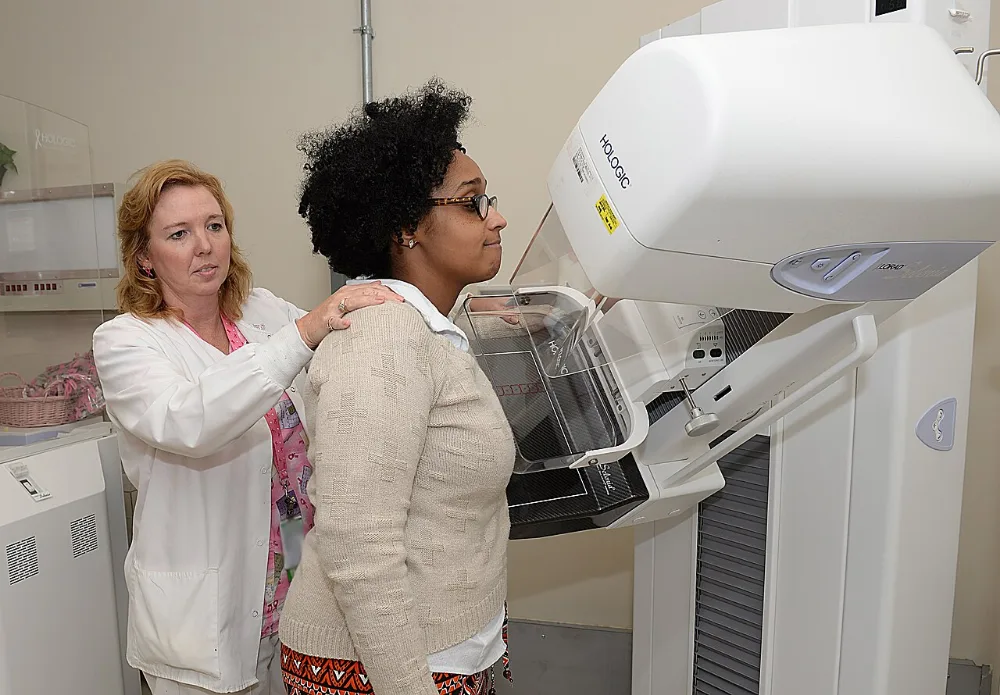
Why from age 40?
The US Preventive Services Task Force concluded that a mammogram every 2 years in women aged 40 to 74 does more good than harm [1]. In the United States, breast cancer became slightly more common every year from 2012 to 2021, and this rise was steeper in women under 50 [4]. On the other hand, starting earlier means more mammograms and a greater chance of a "suspicious result" that later turns out not to be cancer [2].
Women at higher than average risk
Based on the ACR recommendations [3]:
- Women with a genetic risk (such as BRCA mutation carriers), women whom a doctor has calculated to be at high risk (1 in 5 or more over a lifetime), and those who had chest radiotherapy at a young age: yearly MRI from age 25 to 30 and a yearly mammogram (starting between ages 25 and 40, depending on the type of risk).
- Mutation carriers who have a yearly MRI can delay mammograms until age 40.
- The reason for this more intensive plan: of every 10 women with a BRCA1 or BRCA2 mutation, about 7 get breast cancer by age 80 [5].
- Women who had breast cancer before age 50, or who have a history of breast cancer and dense breasts: a yearly supplemental MRI.
- All women, especially Black women and women of Ashkenazi Jewish descent, should have a risk assessment by age 25.
The US Preventive Services Task Force considers the evidence insufficient for extra ultrasound or MRI in women with a normal mammogram but dense breasts [1]. The American College of Radiology suggests MRI for these women if they want further imaging, and contrast-enhanced mammography or ultrasound if MRI is not possible [3].
Related questions
Can a breast examination by a doctor replace a mammogram?
No. The American Cancer Society does not consider a doctor's examination a substitute for a mammogram [2]. But if you have a lump or a symptom, do not wait for your mammogram appointment; see a doctor.
Is a yearly mammogram better than one every 2 years?
Related cancer types
References
5 referencesShow all references, 5 with a study cardClose the reference list
Numbers in the text, such as [1], refer to these sources. Sources with a “Study card” button are summarised in the site’s evidence library.
- 1
- 2
- 3
- 4Breast cancer statistics 2024
- 5Risks of Breast, Ovarian, and Contralateral Breast Cancer for BRCA1 and BRCA2 Mutation Carriers
This page is based on reputable scientific sources and was last updated on 28 October 2026. The content of this website is for educational and informational purposes only and does not replace consultation, diagnosis or treatment by a specialist physician. Consult your treating physician about any treatment decision.
Printed from the website; the full and up-to-date version: https://drdabiri.com/en/questions/mammography-age/