Basal cell and squamous cell skin cancers usually appear as a sore that does not heal, or an area of skin that is raised, smooth, shiny and pearly; firm and like a scar; or red, scaly, bleeding or crusted [3]. Melanoma is usually a mole that changes in size, shape or colour, has an irregular edge, is multicoloured or asymmetrical, or itches, oozes or bleeds [4]. Most moles and skin spots are harmless, but show any new or changing spot to your doctor.
Key points
- Basal cell and squamous cell skin cancers are much more common than melanoma but rarely cause death [1].
- Melanoma is the most dangerous type; it is often dark, but sometimes it has no pigment and looks skin-coloured or pink [2].
- Long exposure to sunlight or sunbeds, fair skin and a history of sunburn are risk factors for basal cell and squamous cell cancers [3].
- The USPSTF considers the evidence insufficient to recommend for or against regular skin examinations for all adults without symptoms [1]; people at high risk should talk to their doctor.
Warning signs of skin cancer
| Sign | Related type | Explanation |
|---|---|---|
| A sore that does not heal | Basal cell and squamous cell | One of the main signs [3] |
| A raised, smooth, shiny and pearly spot | Basal cell and squamous cell | One of the signs listed [3] |
| A firm, scar-like area (white, yellow or waxy) | Basal cell and squamous cell | One of the signs listed [3] |
| A red or reddish-brown spot that is scaly, bleeding or crusted | Basal cell and squamous cell | One of the signs listed [3] |
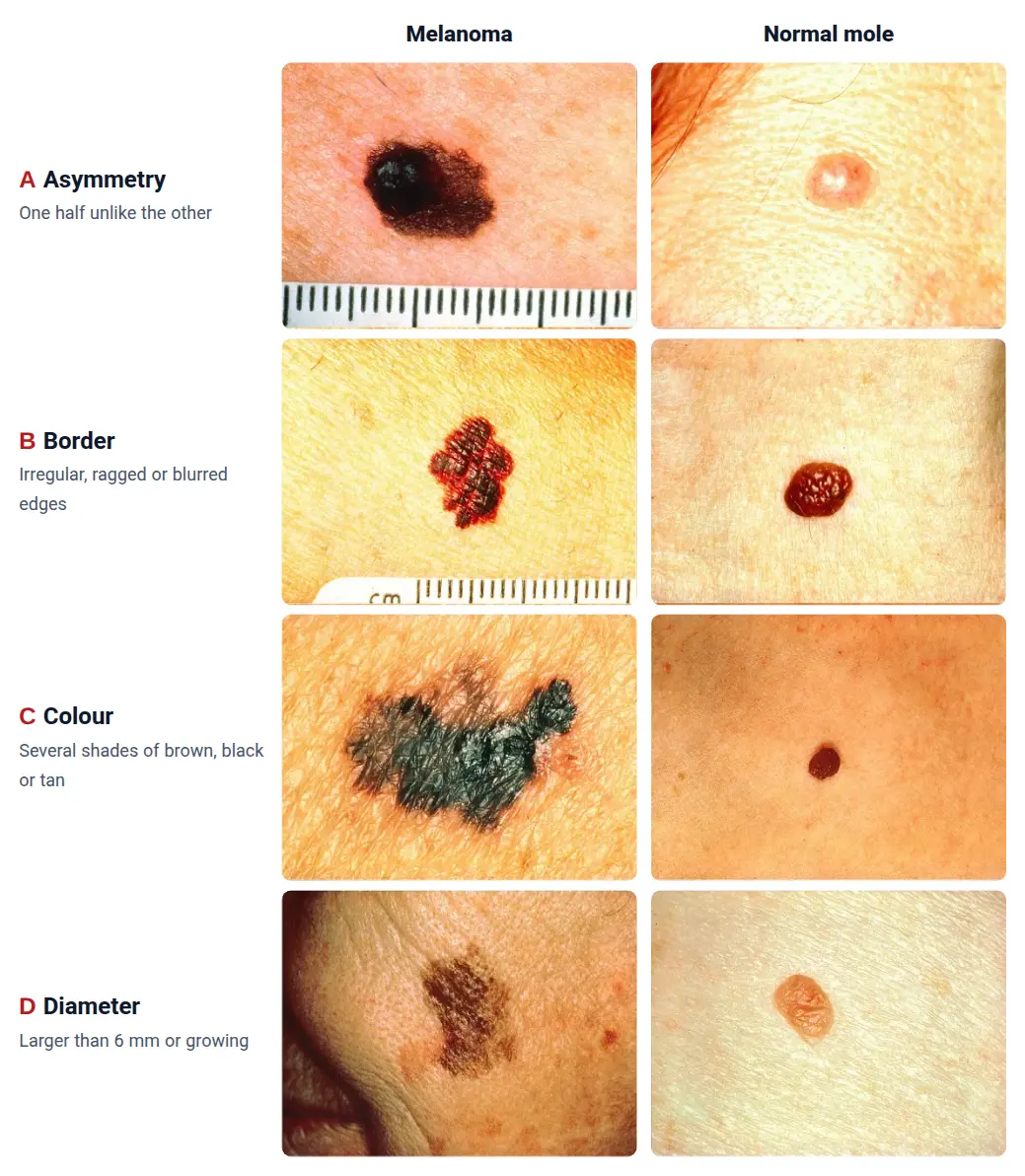
| A — Asymmetry | Melanoma | The two halves of the mole do not match [4] |
| B — Irregular border | Melanoma | Ragged or uneven edges [4] |
| C — Uneven colour | Melanoma | More than one colour in one mole [4] |
| D — Diameter | Melanoma | Melanoma is usually larger than 6 mm, although it may be smaller [4] |
| E — Evolving | Melanoma | A change in the size, shape or colour of a mole over time [4] |
| Itching, oozing, bleeding or ulceration of a mole; new moles next to a mole | Melanoma | One of the signs listed [4] |
Most moles and spots are harmless; this table does not replace an examination by a doctor.
The path to diagnosis
When should I call my doctor?
If you have a sore that has not healed for several weeks, or a mole that has changed, bleeds, itches or looks different from your other moles, show it to your doctor or a dermatologist. Take photos of a suspicious spot so changes are easier to see. Most of these spots are harmless, but finding melanoma early is very important.
Related questions
I have a lot of moles; should I worry?
Most moles are harmless. What matters is change: a mole that changes in size, shape or colour, or that itches or bleeds, should be checked [4].
Does melanoma only develop on sun-exposed areas?
No. Most cases are linked to ultraviolet radiation, but some subtypes (such as melanoma of the palms and soles, or mucosal melanoma) have no link to the sun [2]. Check the soles of your feet and between your toes too.
Does sunscreen really work?
Yes; in a rigorous study, regular sunscreen use was linked to less melanoma over long-term follow-up [5].
Related cancer types
References
5 referencesShow all references, 3 with a study cardClose the reference list
Numbers in the text, such as [1], refer to these sources. Sources with a “Study card” button are summarised in the site’s evidence library.
- 1Screening for Skin Cancer
- 2
- 3
- 4
- 5Reduced Melanoma After Regular Sunscreen Use: Randomized Trial Follow-Up
This page is based on reputable scientific sources and was last updated on 28 October 2026. The content of this website is for educational and informational purposes only and does not replace consultation, diagnosis or treatment by a specialist physician. Consult your treating physician about any treatment decision.
Printed from the website; the full and up-to-date version: https://drdabiri.com/en/questions/symptoms-of-skin-cancer/