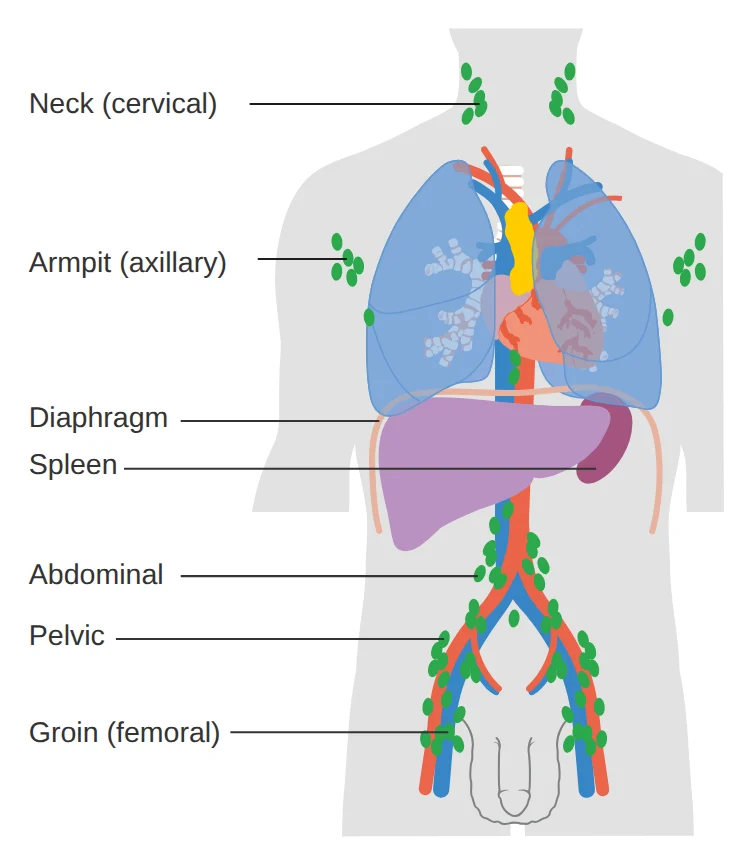
The commonest symptom of lymphoma is a painless swelling of the lymph nodes in the neck, armpit or groin that does not go down after a few weeks [1, 2]. Other symptoms are unexplained fever, drenching night sweats that soak your clothes and bedding, unexplained weight loss, severe tiredness and itchy skin [1, 2]. Most swollen lymph nodes are caused by simple infections and shrink on their own; but a lymph node that has been there for more than 4 weeks, or comes with fever, night sweats and weight loss, should be examined, and if no cause is found, a sample (biopsy) should be taken [3].
Key points
- A painless swollen lymph node that lasts for several weeks is the commonest symptom of lymphoma [1, 2].
- Unexplained fever, drenching night sweats and unexplained weight loss are three important symptoms of lymphoma; doctors call them "B symptoms" [2, 4].
- Most swollen glands are not cancer: of every 100 people who see their family doctor with an enlarged lymph node that has no obvious cause, only about one has cancer; the chance is higher after the age of 40 [3].
- Only a biopsy of the lymph node confirms the diagnosis; do not take steroids on your own before the diagnosis, because they can delay it [3, 4].
Symptoms of lymphoma
| Symptom | What it is like | What to do |
|---|---|---|
| Painless swollen lymph nodes | In the neck, armpit or groin; it stays and does not go down [1, 2] | If it lasts more than 4 weeks, see your doctor [3] |
| Unexplained fever | A temperature of 38°C or higher with no clear cause such as a cold [1, 4] | Have a long-lasting or recurring fever checked |
| Drenching night sweats | Sweating that soaks your nightclothes and sheets and keeps coming back [1, 4] | If it happens night after night, tell your doctor |
| Unexplained weight loss | Losing more than a tenth of your body weight in 6 months without dieting [4] | See your doctor to find the cause |
| Itchy skin | Long-lasting itching; in Hodgkin lymphoma it is sometimes worse after a bath or after drinking alcohol [1, 4] | Tell your doctor about unexplained, long-lasting itching |
| Severe tiredness | Feeling very tired [1, 2] | If it comes with other symptoms, see your doctor |
| Pain in the chest, abdomen or bones | Pain with no clear cause [2] | See your doctor to have it checked |
| Breathlessness, or pain in a lymph node after drinking alcohol | Together with a swollen lymph node, these are symptoms doctors pay particular attention to [5] | Severe breathlessness: emergency |
This table does not replace an examination by a doctor; most swollen lymph nodes are caused by infections and get better on their own [3].
When is a swollen lymph node worrying?
Most of the time it is an infection
These lymph nodes should be checked
A lymph node that has been there for more than 4 weeks; lymph nodes swollen in two parts of the body at the same time; a lymph node above the collarbone; or a lymph node that comes with fever, night sweats and weight loss. Being over 40 also makes cancer more likely [3].
The path to diagnosis
- 1
- 2
Blood tests and imaging
Blood tests help find other causes such as infection. An ultrasound or CT scan shows the lymph node better, but if the node looks suspicious it should not delay the biopsy [3].
- 3
Biopsy of the lymph node
Lymphoma can only be diagnosed by looking at the lymph node tissue under a microscope. It is best to remove the whole node, or a piece with a thicker (core) needle [2, 4]; a fine-needle sample does not show the structure of the node and may not be enough for lymphoma [3]. Read more: Does a biopsy make cancer spread?
- 4
Finding the type and stage
If it is lymphoma, special tests on the sample show the exact type, and a PET-CT scan shows how far the disease has spread [2, 8]. Read more: What is a PET scan? and the full guide to lymphoma.
When should I call my doctor?
See your doctor if you have a lump in your neck, armpit or groin that has been there for more than 4 weeks or is getting bigger, or if you find a lump above your collarbone. Go sooner if a swollen lymph node comes with fever, drenching night sweats or unexplained weight loss.
Severe breathlessness, sudden swelling of the face and neck, or a high fever with shivering need urgent care at an emergency department. Until the diagnosis is clear, do not take steroids on your own [3].
Who is at higher risk?
- Age: Hodgkin lymphoma is most common in young adults aged 20 to 39 and again in later life [1]; non-Hodgkin lymphoma becomes more common with age [2].
- Being male slightly raises the risk of both types [1, 2].
- A weakened immune system: inherited immune disorders, autoimmune diseases, HIV infection, or immune-suppressing medicines after an organ transplant [2].
- Some infections: the Epstein-Barr virus and the stomach bacterium Helicobacter pylori are linked to some lymphomas [1, 2].
- Family history: having a parent, brother or sister with Hodgkin lymphoma [1].
Lymphoma can also develop in people who have none of these risk factors [2], so if you have symptoms, do not wait for a "risk factor".
Frequently asked questions
When is a swollen lymph node in the neck dangerous?
Most lumps in the neck are caused by infections. A lymph node that lasts more than 4 weeks, sits above the collarbone, or comes with fever, night sweats and weight loss should be checked, especially after the age of 40 [3]. If a neck lump comes with a mouth ulcer or a hoarse voice, also see symptoms of mouth cancer.
Is a painful lymph node a sign of lymphoma?
When are night sweats a sign of lymphoma?
Is itching a sign of lymphoma?
Can a blood test or an ultrasound diagnose lymphoma?
Can tuberculosis cause swollen lymph nodes?
Yes. Some infections, including bacteria of the tuberculosis family, cause lymph nodes that stay swollen for months and can be mistaken for cancer [3]. That is why a biopsy clarifies the cause when a lymph node does not go away.
Is lymphoma curable?
Many lymphomas can be cured. For example, in a large study of advanced Hodgkin lymphoma, about 9 in every 10 patients were alive 6 years later [9]. The type and stage of the lymphoma decide the treatment; see the guide to lymphoma.
Referral criteria and diagnostic points (for physicians)
For physicians
NICE NG12 (last updated April 2026). In adults with unexplained lymphadenopathy, and for non-Hodgkin lymphoma also unexplained splenomegaly, consider a suspected cancer pathway referral (diagnosis or exclusion of cancer within 28 days); when deciding, take into account fever, night sweats, shortness of breath, pruritus and weight loss, and for Hodgkin lymphoma alcohol-induced lymph node pain. In children and young people (up to 24 years) the same findings call for a very urgent referral (within 48 hours) [5].
Pre-test probability. The annual incidence of unexplained lymphadenopathy in primary care is 0.6%, and only 1.1% of cases are malignant: 4% in patients aged 40 and older versus 0.4% in those younger than 40. Supraclavicular lymphadenopathy has been malignant in 34% to 50% of cases. Risk factors for malignancy: age over 40, duration longer than 4 to 6 weeks, involvement of two or more regions, a node not back to baseline after 8 to 12 weeks, supraclavicular location, systemic symptoms and hepatosplenomegaly. Localised lymphadenopathy in which malignancy is unlikely can be observed for 4 weeks [3].
In patients aged 40 and older (CPRD case-control studies). Lymphadenopathy was the strongest feature: OR 263 (133 to 519) for non-Hodgkin lymphoma [6] and 280 (25 to 3100) for Hodgkin lymphoma [7]; the positive predictive value of lymphadenopathy in those aged 60 and older was 13% for non-Hodgkin lymphoma [6] and 5.6% for Hodgkin lymphoma [7].
Diagnosis and staging. Biopsy, preferably excisional, interpreted by a qualified pathologist [4]; the reliability of FNA in lymphoma is questioned because it cannot show nodal architecture, and corticosteroids before a tissue diagnosis may mask or delay the diagnosis of leukaemia or lymphoma [3]. B symptoms: unexplained fever above 38°C, drenching and recurrent night sweats, weight loss of more than 10% in the 6 months before diagnosis [4]. In the Lugano classification, PET-CT is part of standard staging for FDG-avid lymphomas, and the A/B suffix is used only for Hodgkin lymphoma [8].
Scientific evidence
Scientific evidence
2 itemsRecommendations for initial evaluation, staging, and response assessment of Hodgkin and non-Hodgkin lymphoma: the Lugano classification
Overall Survival with Brentuximab Vedotin in Stage III or IV Hodgkin's Lymphoma
Related cancer types
References
9 referencesShow all references, 2 with a study cardClose the reference list
Numbers in the text, such as [1], refer to these sources. Sources with a “Study card” button are summarised in the site’s evidence library.
- 1
- 2
- 3
- 4
- 5
- 6
- 7
- 8Recommendations for initial evaluation, staging, and response assessment of Hodgkin and non-Hodgkin lymphoma: the Lugano classification
- 9Overall Survival with Brentuximab Vedotin in Stage III or IV Hodgkin's Lymphoma
This page is based on reputable scientific sources and was last updated on 28 October 2026. The content of this website is for educational and informational purposes only and does not replace consultation, diagnosis or treatment by a specialist physician. Consult your treating physician about any treatment decision.
Printed from the website; the full and up-to-date version: https://drdabiri.com/en/questions/symptoms-of-lymphoma/