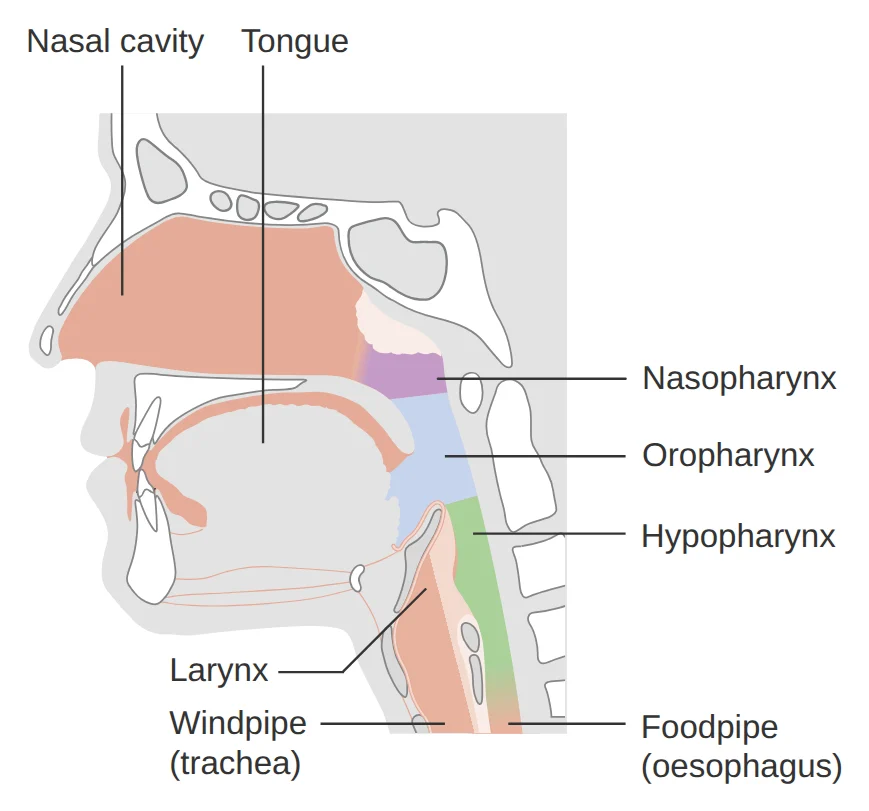
"Throat cancer" means cancer of the pharynx (including the tonsils and the base of the tongue) or of the larynx, the voice box that holds the vocal cords [1, 2]. The main symptoms are a hoarse voice that does not get better, a lasting sore throat, pain or difficulty swallowing, ear pain, a cough that does not go away and a lump in the neck, which is sometimes the only sign [1, 2, 3, 7]. Most of these symptoms have a simpler cause, but hoarseness that has lasted more than 4 weeks, or a neck lump that has been there for 2 weeks or more without getting smaller, should be examined by a doctor, ideally an ear, nose and throat (ENT) specialist [6, 7].
Key points
- "Throat cancer" covers two areas: the pharynx (from behind the nose and mouth down to the top of the oesophagus) and the larynx (the voice box, where the vocal cords are) [1, 2].
- Hoarseness that has lasted more than 4 weeks should be checked by looking at the voice box; sooner if you smoke or have a neck lump [6]. Because cancer of the vocal cords changes the voice early, it is often found early [12].
- A new neck lump in an adult that has been there for 2 weeks or more and has no infectious cause should be checked; sometimes it is the only sign of throat cancer [7].
- There is no home test for throat cancer; it is diagnosed by looking inside the throat with a thin camera and taking a biopsy [1].
- Smoking and other tobacco, alcohol, opium and the HPV virus are the main risk factors; stopping smoking halves the risk within 5 to 9 years [4, 9].
- Small cancers of the voice box that have not reached the lymph nodes are cured in most people with radiotherapy or surgery [12].
What are the symptoms of throat cancer?
The symptoms depend on where in the throat the tumour starts [1, 2, 3]. Cancer of the vocal cords makes the voice rough or hoarse early, so it is often found early [12]. Cancer of the lower part of the pharynx (behind the voice box) rarely causes symptoms at first and is usually found later [3]. Cancer of the tonsils and the base of the tongue, which is mostly linked to the HPV virus, sometimes shows itself only as a lump in the neck [2, 7, 11].
| Symptom | What it may point to | What to do |
|---|---|---|
| A hoarse or changed voice that does not get better | One of the main symptoms of cancer of the voice box; cancer of the vocal cords is often found early because of it [1, 12] | If it has lasted more than 4 weeks, the voice box should be examined; sooner for smokers and people with a neck lump [6] |
| A sore throat or cough that does not go away | A symptom of cancer of the pharynx and larynx [1, 2, 3] | If it does not get better, see an ear, nose and throat specialist |
| Pain or difficulty when swallowing | A symptom of cancer of the pharynx and larynx [1, 2, 3]; difficulty swallowing can also come from the oesophagus [5] | Have difficulty swallowing checked without delay [5] |
| Ear pain | Pain that spreads from the throat to the ear, even when the ear itself is healthy [1, 3, 12] | If the ear is healthy and the pain goes on, the throat should be examined too |
| A lump in the neck | May be a lymph node the cancer has reached; sometimes it is the only sign [7] | If it has been there for 2 weeks or more without getting smaller, have it checked [7] |
| A feeling of a lump in the throat | A symptom of cancer of the voice box [1] | If it lasts or comes with other symptoms, see a doctor |
| Trouble opening the mouth or moving the tongue, weight loss without a reason, or coughing up blood | Symptoms of cancer of the tonsils and base of the tongue [2] | See a doctor soon |
| Shortness of breath or a noisy, harsh sound when breathing | May be a sign that the airway is narrowing and needs urgent assessment [6] | Emergency |
This table does not replace an examination by a doctor; in most people these symptoms have a simpler cause.
 (full-size image, opens in a new tab)
Long-lasting hoarseness: when is it a worry?
A hoarse voice is very common: almost 1 in 3 people have it at some point in their lives [6]. The American ear, nose and throat specialists' guideline says that if hoarseness has not gone away or improved after 4 weeks, a doctor should look at the voice box or send you to someone who can [6].
Do not wait 4 weeks, and see a doctor sooner, if [6]:
- you smoke, use a hookah or other tobacco, or used to
- you have a lump in your neck
- breathing has become hard, or your breathing makes a harsh or whistling sound
- you have recently had surgery on the head, neck or chest, or had a breathing tube put in for an anaesthetic
The same guideline advises against routinely giving antibiotics for hoarseness, and against prescribing steroids or reflux medicine for hoarseness alone before the voice box has been seen [6]. The English national guideline also suggests fast referral to check for cancer of the voice box in people aged 45 or over with lasting, unexplained hoarseness [5].
A lump in the neck: when should it be checked?
In children most neck lumps are caused by infection, but in adults a lump that does not go away is often a tumour and should be taken seriously until the cause is clear [7]. Sometimes a painless neck lump is the first or only sign of throat cancer [7].
These lumps need to be checked [7]:
- a lump that has been there for 2 weeks or more without getting smaller, and is not explained by a cold or another infection
- a lump that is firm, stuck to the tissue around it so it does not move under your fingers, larger than 1.5 cm, or with broken skin over it
Antibiotics are not recommended for such a lump unless there are signs of a bacterial infection [7]. The doctor will usually look inside the throat and voice box, ask for a CT or MRI scan of the neck with contrast, and take a sample from the lump with a thin needle [7]. Neck lumps have other causes too; read: symptoms of thyroid cancer and symptoms of lymphoma.
When should I contact a doctor?
Most sore throats and hoarse voices get better on their own. But see a doctor, ideally an ear, nose and throat specialist, if you have:
- hoarseness that has lasted more than 4 weeks; sooner if you smoke or have a neck lump [6]
- a lump in the neck that has been there for 2 weeks or more without getting smaller [7]
- a sore throat, pain or difficulty swallowing, or ear pain that does not go away [1, 3]
- coughing up blood or weight loss without a reason [2]
Shortness of breath, a harsh or whistling sound when breathing, heavy bleeding from the mouth or throat, or being unable to swallow water or your own saliva need urgent help: call your local emergency number.
How do I know if I have throat cancer? Is there a home test?
There is no test for throat cancer that you can do at home. It is diagnosed by a doctor's examination, looking inside the throat with a camera and taking a small piece of tissue (a biopsy) [1]. Even for hoarseness, the guideline says a CT or MRI scan is not needed before the voice box has been looked at [6]. The usual steps are:
- 1
Examining the throat and neck
The doctor looks inside the mouth and throat and feels the neck for lumps or enlarged lymph nodes [1].
- 2
- 3
Biopsy
A firm diagnosis can only be made by looking at a small piece of tissue under a microscope [1]. For a neck lump, the sample is usually taken with a thin needle [7]. Worried about having a biopsy? Read: Can a biopsy spread cancer?
- 4
HPV test
In cancer of the tonsils and base of the tongue, the sample is also tested for the HPV virus, because this changes the outlook and the treatment [2].
- 5
Scans and staging
A CT, MRI or PET scan shows how far the tumour has spread [1]. Read more: What is a PET scan? and cancer stages.
Who is more at risk?
Smoking and other tobacco
This is the main cause. The risk of these cancers is about 5 to 10 times higher in smokers than in people who have never smoked, and all kinds of tobacco, from cigarettes and pipes to chewing tobacco, carry a risk [4]. A hookah (waterpipe) also burns tobacco; read: Does hookah smoking cause cancer?
Alcohol
Alcohol raises the risk a lot, especially together with smoking [4]. In a large analysis, almost 9 in 10 cancers of the voice box and about 7 in 10 cancers of the pharynx were linked to tobacco or alcohol [8]. Read more: Does alcohol cause cancer?
Opium
In the Golestan study of more than 50,000 people in north-east Iran, opium use was linked to more than twice the risk of cancer of the voice box; the more opium, the higher the risk [9]. Read more: Does opium cause cancer?
The HPV virus
Most cancers of the tonsils and base of the tongue in the United States are linked to this virus [11]. HPV is spread mainly through sexual contact, and people with an HPV-16 infection in the mouth are about 15 times more likely to get cancer of the tonsils and base of the tongue [4]. The HPV vaccine greatly lowers the chance of an HPV infection in the mouth, but it is not yet known whether it also prevents this cancer [4]. Read: the HPV vaccine.
Stopping smoking is the most effective step: the risk of these cancers halves within 5 to 9 years of stopping, and after about 20 years it is the same as for someone who has never smoked [4]. Read: How much does stopping smoking lower cancer risk? Give up alcohol and opium too; both are linked to a higher risk [4, 9].
Is throat cancer curable? Chances of cure and survival
Often, yes; the earlier it is found, the better the chance of cure. Small cancers of the voice box that have not yet reached the lymph nodes are cured in most people: from at least 3 in 4 patients up to more than 9 in 10, depending on where the tumour is and how big it is [12]. At this stage radiotherapy or surgery alone is usually enough, and radiotherapy can be a good choice for keeping the voice [12].
In the United States, about 6 in 10 people with cancer of the voice box are alive 5 years later [11]. HPV-related cancer of the tonsils and base of the tongue responds better to treatment and comes back less often [2]: in a large study of people with more advanced disease, about 8 in 10 patients with HPV-positive tumours were alive 3 years after treatment [10].
These numbers are averages from many patients and cannot say exactly what will happen to one person. Read about treatment: treating head and neck cancers by stage.
Frequently asked questions
What does throat cancer feel like?
At first many people notice only a small change: a voice that stays rough or hoarse, a sore throat that does not get better, a feeling of a lump in the throat, pain when swallowing, or ear pain that comes from the throat [1, 12]. Some have no pain at all and only find a lump in the neck [7]; so a lump being painless does not mean it is harmless.
What are the signs of throat cancer in women?
The symptoms in women are the same as in men: hoarseness, a lasting sore throat, pain or difficulty swallowing, ear pain and a neck lump [1, 2]. These cancers are much more common in men; in the United States about 1 in 5 people with cancer of the pharynx or larynx is a woman [11]. Women who smoke cigarettes or a hookah are also at risk and should take these symptoms seriously [4].
My sore throat has not gone away for weeks; could it be cancer?
My doctor says my hoarseness is from reflux; should I just take stomach tablets?
Reflux can be one of the causes. But the ear, nose and throat specialists' guideline says reflux medicine should not be prescribed for hoarseness that is the only symptom without the voice box being looked at [6]. If the hoarseness has lasted more than 4 weeks, have the voice box examined first [6].
Are antibiotics enough for a neck lump?
If there are no signs of a bacterial infection, antibiotics are not recommended [7]. A lump that has been there for 2 weeks or more without getting smaller should be checked; even if it looks like a cyst (filled with fluid) on an ultrasound scan or needle test, it should be followed up until the cause is clear [7].
How is throat cancer different from mouth and oesophageal cancer?
Mouth cancer most often shows itself as a mouth ulcer that has not healed after 3 weeks, and difficulty swallowing can come from cancer of the oesophagus [5]. Read: symptoms of mouth cancer and symptoms of oesophageal cancer.
Is throat cancer contagious?
No, the cancer itself is not contagious. The HPV virus, which plays a part in some cancers of the tonsils and base of the tongue, is spread mainly through sexual contact [4]. Read: Is cancer contagious?
Is cancer behind the nose (nasopharyngeal cancer) a throat cancer?
The area behind the nose is the top part of the pharynx [2]. Cancer of this area is explained separately on the head and neck cancers page: nasopharyngeal cancer.
Referral criteria and clinical points (for doctors)
For physicians
NICE NG12 (last updated April 2026). Consider a suspected cancer pathway referral for laryngeal cancer in people aged 45 and over with persistent and unexplained hoarseness or an unexplained lump in the neck (recommendation 1.8.1); and for oral cancer with unexplained ulceration in the oral cavity lasting more than 3 weeks or a persistent and unexplained lump in the neck (1.8.2). Refer anyone with dysphagia on a suspected cancer pathway for oesophageal cancer (1.2.1) [5].
Dysphonia (AAO-HNSF guideline, 2018). Perform laryngoscopy, or refer to a clinician who can, when dysphonia fails to resolve or improve within 4 weeks, or irrespective of duration if a serious underlying cause is suspected. Factors that call for expedited evaluation: recent surgery involving the head, neck or chest, recent endotracheal intubation, a concomitant neck mass, respiratory distress or stridor, a history of tobacco use and professional voice use. Recommendations against: routine antibiotics (strong recommendation), CT or MRI before the larynx has been visualised, antireflux medication for isolated dysphonia based on symptoms alone without laryngeal visualisation, and routine corticosteroids before laryngeal visualisation [6].
Neck mass in adults (AAO-HNSF guideline, 2017). The risk of malignancy is increased when there is no history of an infectious cause and the mass has been present for ≥2 weeks without significant fluctuation or is of uncertain duration, or when on examination it is fixed to adjacent tissues, firm, larger than 1.5 cm or associated with ulceration of the overlying skin. In these patients: neck CT (or MRI) with contrast (strong recommendation), visualisation of the mucosa of the larynx, base of tongue and pharynx, FNA instead of open biopsy, continued evaluation of a cystic neck mass until a diagnosis is obtained (do not assume it is benign), and examination of the upper aerodigestive tract under anaesthesia before open biopsy if no primary site is found. Routine empirical antibiotics are not recommended without signs of bacterial infection [7].
Prognosis. In laryngeal cancer, the prognosis of small lesions without lymph node involvement is very good, with cure rates of 75% to 95% depending on the site, tumour bulk and depth of infiltration; most early lesions can be cured by radiotherapy or surgery, and radiotherapy is reasonable to preserve the voice, leaving surgery for salvage [12]. Five-year relative survival in the United States (diagnosed 2015–2021): larynx 62% and oral cavity and pharynx 69% [11]. In the retrospective analysis of RTOG 0129 (stage III–IV oropharyngeal SCC, median follow-up 4.8 years), 63.8% of tumours (206 of 323) were HPV-positive; 3-year overall survival was 82.4% vs 57.1% (P<0.001), and after adjustment the HR for death was 0.42 (95% CI 0.27 to 0.66); the risk of death rose with each additional pack-year of smoking [10].
Risk factors. In the pooled INHANCE analysis (11,221 cases and 16,168 controls), the joint effect of tobacco and alcohol was greater than multiplicative (psi 2.15; 95% CI 1.53 to 3.04), and their population attributable risk was 89% for the larynx and 72% for the pharynx [8]. In the Golestan cohort (50,045 people, median follow-up 10 years), opium use was associated with laryngeal cancer (HR 2.53; 95% CI 1.21 to 5.29) in a dose-dependent manner [9]. Oral HPV-16 infection raises the risk of oropharyngeal cancer about 15-fold [4].
Scientific evidence
Scientific evidence
3 itemsHuman Papillomavirus and Survival of Patients with Oropharyngeal Cancer
Interaction between Tobacco and Alcohol Use and the Risk of Head and Neck Cancer: Pooled Analysis in the International Head and Neck Cancer Epidemiology Consortium
Opium use and subsequent incidence of cancer: results from the Golestan Cohort Study
Related cancer types
Related questions
References
12 referencesShow all references, 4 with a study cardClose the reference list
Numbers in the text, such as [1], refer to these sources. Sources with a “Study card” button are summarised in the site’s evidence library.
- 1
- 2
- 3
- 4
- 5
- 6
- 7
- 8Interaction between tobacco and alcohol use and the risk of head and neck cancer: pooled analysis in the International Head and Neck Cancer Epidemiology Consortium
- 9
- 10Human papillomavirus and survival of patients with oropharyngeal cancer
- 11
- 12
This page is based on reputable scientific sources and was last updated on 28 October 2026. The content of this website is for educational and informational purposes only and does not replace consultation, diagnosis or treatment by a specialist physician. Consult your treating physician about any treatment decision.
Printed from the website; the full and up-to-date version: https://drdabiri.com/en/questions/symptoms-of-throat-cancer/