About this list
- This page brings together 10 cheap, accessible actions that have strong evidence but are often skipped in practice; each links to its study card and exact dose.
- In Iran stomach, breast and lung cancer cause the most cancer deaths (about 97,700 cancer deaths a year) [1]; most of these actions relate directly to these cancers.
- To share in medical groups: a one-page PDF for printing, or an image of the same sheet for WhatsApp and Telegram (in Persian).
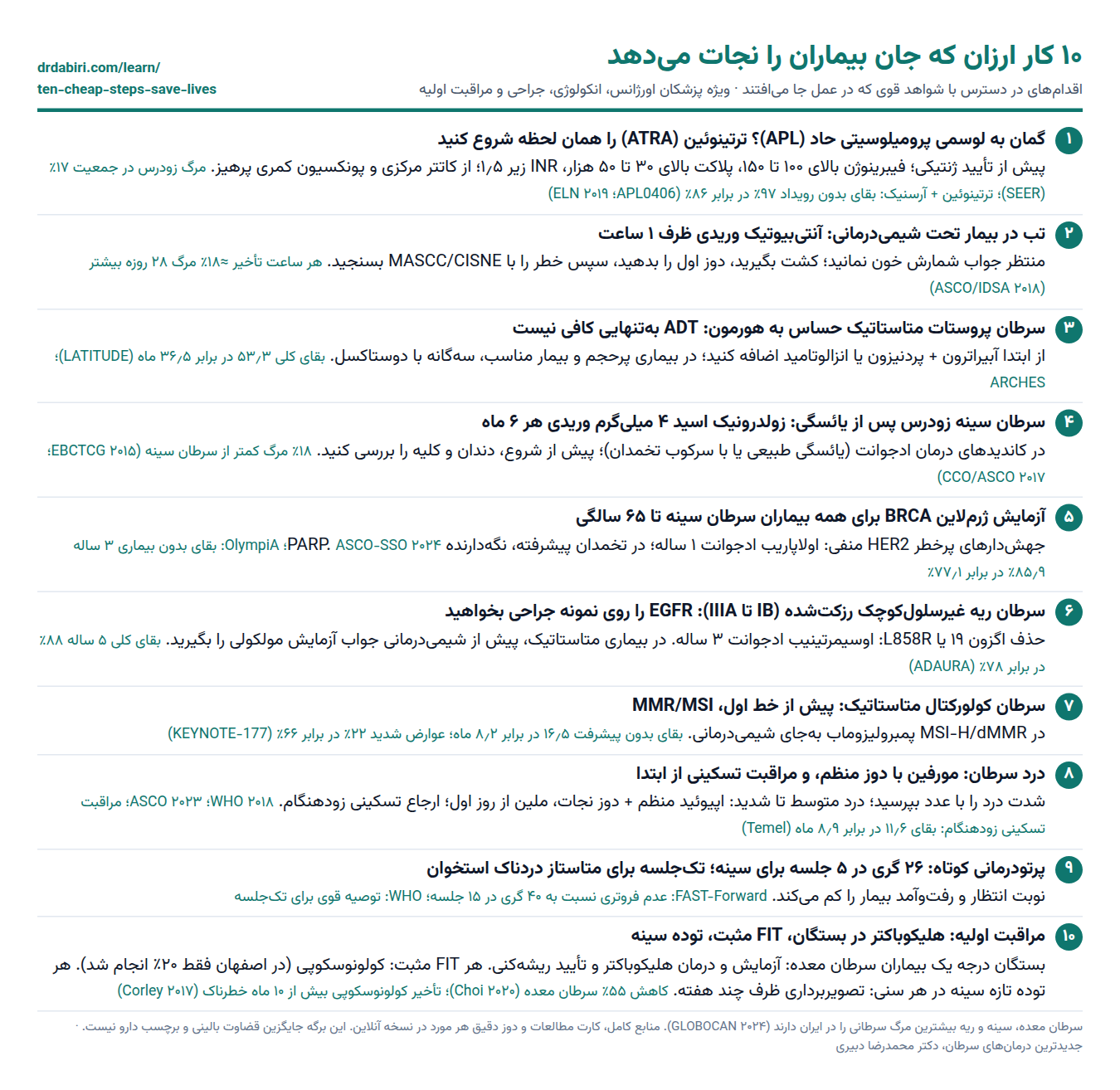
Summary at a glance
| # | Action | For whom | Key evidence |
|---|---|---|---|
| 1 | Tretinoin (ATRA) the moment APL is suspected | Emergency, internal medicine, haematology | ELN 2019; early death 17% in the population [2, 3] |
| 2 | IV antibiotics within 1 hour in febrile neutropenia | Emergency, oncology | Each hour of delay ≈18% more deaths [6] |
| 3 | No ADT alone: add abiraterone or enzalutamide in mHSPC | Urology, oncology | LATITUDE, ARCHES [8, 9] |
| 4 | Adjuvant zoledronic acid after menopause | Oncology, breast surgery | EBCTCG: 18% fewer breast cancer deaths [10] |
| 5 | Germline BRCA testing up to age 65 | Oncology, surgery, gynaecology | ASCO-SSO 2024; OlympiA [12, 13] |
| 6 | EGFR testing in resected NSCLC | Thoracic surgery, oncology, pathology | ADAURA: 5-year survival 88% vs 78% [14] |
| 7 | MMR/MSI testing in metastatic colorectal cancer | Oncology, pathology | KEYNOTE-177 [15] |
| 8 | Regular-dose morphine and early palliative care | All doctors | WHO 2018; Temel 2010 [16, 18] |
| 9 | 5-fraction breast radiotherapy and single-fraction radiotherapy for painful bone metastases | Radiotherapy | FAST-Forward; WHO [16, 19] |
| 10 | H. pylori treatment in relatives and colonoscopy after a positive FIT | Family medicine, gastroenterology | Choi 2020; Isfahan 2024 [20, 21, 22] |
1. Tretinoin (ATRA) the moment acute promyelocytic leukaemia is suspected
Why: APL is almost always curable with today's treatment, but patients die of bleeding before or at the start of treatment. In population SEER data (1,400 patients), early mortality was 17.3% and 24.2% at age 55 and over; the authors called for education of front-line doctors [3].
What to do: with a suspicious peripheral smear (abnormal promyelocytes, especially with DIC), start tretinoin before genetic confirmation (ELN, level Ib–A). Keep fibrinogen above 100 to 150 mg/dL, platelets above 30 to 50 × 10⁹/L and INR below 1.5. Avoid central venous catheters, lumbar puncture and other invasive procedures before and during induction [2].
Evidence: in low- to intermediate-risk APL, tretinoin + arsenic trioxide without chemotherapy gave 2-year event-free survival of 97% vs 86% [4]; ELN considers this regimen the standard [2].
Study card and dose: APL0406 card (Persian) · tretinoin + arsenic trioxide dose
2. IV antibiotics within 1 hour in febrile neutropenia
Why: in a prospective cohort, each hour of delay in the first antibiotic dose was associated with about an 18% increase in 28-day mortality [6].
What to do: in a patient on chemotherapy with fever, do not wait for the blood count: take cultures and give the first dose of empirical antibiotic within 1 hour of triage; then assess risk with MASCC or CISNE [5].
Evidence: ASCO/IDSA 2018 guideline [5].
Study card and dose: ASCO/IDSA card (Persian) · cefepime and other regimen doses (Persian)
3. In metastatic hormone-sensitive prostate cancer, ADT alone is not enough
Why: a systematic review of 29 real-world studies showed that ADT alone dominates in every region and that combinations are used least in Asia [7], while adding an androgen receptor pathway inhibitor extends survival by years [8].
What to do: in every mHSPC patient, combine ADT from the start with abiraterone + prednisone or enzalutamide; in de novo high-volume disease and a fit patient, consider triplet therapy with docetaxel.
Evidence: LATITUDE: median overall survival 53.3 vs 36.5 months (HR 0.66) [8]; ARCHES: HR for radiographic progression or death 0.39 [9].
Study card and dose: LATITUDE card (Persian) · ARCHES card (Persian) · ADT + abiraterone dose · ADT + enzalutamide dose · triplet therapy
4. Adjuvant zoledronic acid in postmenopausal early breast cancer
Why: in the EBCTCG individual-patient meta-analysis, in postmenopausal women adjuvant bisphosphonates reduced distant recurrence (RR 0.82), bone recurrence (RR 0.72) and breast cancer death (RR 0.82); no effect was seen before menopause [10]. The drug is cheap and accessible.
What to do: in every postmenopausal woman (natural or with ovarian suppression) who is a candidate for adjuvant systemic therapy, consider zoledronic acid 4 mg IV every 6 months; before starting, assess risk factors for osteonecrosis of the jaw and kidney function, and treat dental problems [11].
Evidence: EBCTCG 2015 [10]; CCO/ASCO 2017 guideline [11].
Study card and dose: EBCTCG card (Persian) · dose (at the bottom of this page)
5. Germline BRCA testing for every breast cancer patient up to age 65
Why: breast cancer occurs earlier in Iran, and a BRCA mutation changes both the patient's treatment (olaparib) and prevention in the family.
What to do: offer BRCA1/2 testing to every newly diagnosed patient aged 65 or younger; over 65 based on personal and family history or candidacy for a PARP inhibitor [12]. In high-risk HER2-negative patients with a mutation, give one year of adjuvant olaparib [13]. In advanced ovarian cancer, BRCA also decides maintenance treatment.
Evidence: OlympiA: 3-year invasive disease-free survival 85.9% vs 77.1% (HR 0.58) and improved overall survival [13].
Study card and dose: OlympiA card (Persian) · adjuvant olaparib dose · olaparib in ovarian cancer (SOLO-1)
6. EGFR testing in resected non-small-cell lung cancer
Why: EGFR testing is sometimes requested only in metastatic disease, whereas the result also changes survival in operable disease [14].
What to do: in stage IB to IIIA non-squamous NSCLC after surgery, test EGFR on the surgical specimen; with an exon 19 deletion or L858R, give 3 years of adjuvant osimertinib [14]. In metastatic disease, too, get the molecular result before chemotherapy (Chemotherapy or targeted therapy?).
Evidence: ADAURA: 5-year overall survival 88% vs 78% (HR 0.49) [14].
Study card and dose: ADAURA card (Persian) · adjuvant osimertinib dose
7. MMR/MSI testing in metastatic colorectal cancer before first-line treatment
Why: in MSI-H/dMMR tumours immunotherapy is more effective and less toxic than chemotherapy; MMR immunohistochemistry is a cheap test.
What to do: before starting first-line treatment for metastatic disease, know the MMR/MSI status; in MSI-H/dMMR choose pembrolizumab instead of chemotherapy [15].
Evidence: KEYNOTE-177: median progression-free survival 16.5 vs 8.2 months (HR 0.60) and grade 3 or higher adverse events 22% vs 66% [15].
Study card and dose: KEYNOTE-177 card (Persian) · pembrolizumab dose
8. Adequate pain treatment with morphine and palliative care from the start
Why: moderate to severe cancer pain is not controlled by simple analgesics, and fear of addiction still blocks prescribing. Early palliative care in metastatic lung cancer improved quality of life and was associated with longer survival (11.6 vs 8.9 months) [18].
What to do: ask about pain severity with a numerical scale; for moderate or severe pain give an opioid (preferably regular-dose oral morphine with immediate-release morphine for rescue), prescribe a laxative from the start, and refer to palliative care early in advanced disease [16, 17].
Evidence: WHO 2018 [16]; ASCO 2023 [17]; Temel 2010 [18].
Study card and dose: early palliative care card (Persian) · morphine dose (WHO)
9. Short-course radiotherapy: 5 fractions for the breast and 1 for painful bone metastases
Why: radiotherapy capacity is limited; short regimens shorten waiting lists and reduce travel costs for patients coming from other cities.
What to do: after surgery for early breast cancer, consider 26 Gy in 5 fractions over 1 week instead of 40 Gy in 15 fractions [19]. For painful bone metastases, single-fraction radiotherapy is recommended [16].
Evidence: FAST-Forward: 26 Gy in 5 fractions was non-inferior for local relapse, with normal-tissue effects similar to 40 Gy at 5 years [19]; WHO: strong recommendation, high-quality evidence for a single fraction [16].
Study card and dose: FAST-Forward card (Persian)
10. Prevention and early diagnosis in primary care: H. pylori, positive FIT and breast lumps
Why: stomach cancer is the leading cause of cancer death in Iran [1]. In the Isfahan FIT programme only about 20% of people with a positive test had a colonoscopy [21], and 45.8% of breast cancer patients are diagnosed at stage 3 or higher [23].
What to do: in first-degree relatives of gastric cancer patients, test for and treat H. pylori and confirm eradication [20]. Actively steer every positive FIT to colonoscopy; a delay of more than 10 months was linked to more and more advanced cancer [22]. Image every new breast lump at any age within a few weeks.
Evidence: Choi 2020: 55% reduction in gastric cancer (HR 0.45) [20]; Corley 2017 [22].
Study card and dose: Choi 2020 card (Persian) · patient page: H. pylori · patient page: positive FIT · patient page: breast lump
Adjuvant zoledronic acid dose
For physicians
Regimens and doses
Adjuvant zoledronic acid (early breast cancer)
Postmenopausal women (natural, or with ovarian suppression or removal) who are candidates for adjuvant systemic therapyCycle length: Every 6 months
Postmenopausal women (natural, or with ovarian suppression or removal) who are candidates for adjuvant systemic therapy
| Drug | Dose | Route | Schedule |
|---|---|---|---|
| Zoledronic acid | 4 mg | Intravenous | Every 6 months |
Alternative: clodronate 1,600 mg a day orally. Before starting, assess risk factors for osteonecrosis of the jaw and renal impairment, and treat dental and oral problems. A definite benefit is seen only in the postmenopausal setting; denosumab was not recommended for this use [10, 11].
Evidence: EBCTCG Bisphosphonate 2015 (2015)
Doses follow the trial protocol, guideline or official drug label (source given in the notes of each regimen). Before prescribing, check blood counts, renal and hepatic function, drug interactions and the patient’s condition, and adjust the dose according to the drug label.
Scientific evidence
Scientific evidence
11 itemsOutpatient Management of Fever and Neutropenia in Adults Treated for Malignancy: American Society of Clinical Oncology and Infectious Diseases Society of America Clinical Practice Guideline Update
Abiraterone acetate plus prednisone in patients with newly diagnosed high-risk metastatic castration-sensitive prostate cancer (LATITUDE): final overall survival analysis of a randomised, double-blind, phase 3 trial
Adjuvant bisphosphonate treatment in early breast cancer: meta-analyses of individual patient data from randomised trials
Overall Survival with Osimertinib in Resected EGFR-Mutated NSCLC
Early palliative care for patients with metastatic non-small-cell lung cancer
Hypofractionated breast radiotherapy for 1 week versus 3 weeks (FAST-Forward): 5-year efficacy and late normal tissue effects results from a multicentre, non-inferiority, randomised, phase 3 trial
Family History of Gastric Cancer and Helicobacter pylori Treatment
Retinoic acid and arsenic trioxide for acute promyelocytic leukemia
ARCHES: A Randomized, Phase III Study of Androgen Deprivation Therapy With Enzalutamide or Placebo in Men With Metastatic Hormone-Sensitive Prostate Cancer
Adjuvant Olaparib for Patients with BRCA1- or BRCA2-Mutated Breast Cancer
Pembrolizumab in Microsatellite-Instability-High Advanced Colorectal Cancer
References
23 referencesShow all references, 11 with a study cardClose the reference list
Numbers in the text, such as [1], refer to these sources. Sources with a “Study card” button are summarised in the site’s evidence library.
- 1
- 2
- 3
- 4Retinoic acid and arsenic trioxide for acute promyelocytic leukemia
- 5Outpatient Management of Fever and Neutropenia in Adults Treated for Malignancy: American Society of Clinical Oncology and Infectious Diseases Society of America Clinical Practice Guideline Update
- 6
- 7Real-world use of androgen-deprivation therapy intensification for metastatic hormone-sensitive prostate cancer: a systematic review
- 8
- 9ARCHES: A Randomized, Phase III Study of Androgen Deprivation Therapy With Enzalutamide or Placebo in Men With Metastatic Hormone-Sensitive Prostate Cancer
- 10
- 11
- 12
- 13
- 14
- 15
- 16
- 17
- 18
- 19
- 20
- 21
- 22
- 23Determinants of delay in diagnosis and end stage at presentation among breast cancer patients in Iran: a multi-center study
This page is based on reputable scientific sources and was last updated on 27 October 2026. The content of this website is for educational and informational purposes only and does not replace consultation, diagnosis or treatment by a specialist physician. Consult your treating physician about any treatment decision.